
Naugatuck Water Company
Public water comes to town
Just around the time when the brooks and streams began to lose their importance to the operation of businesses in town, their existence took on a different value: providing the basis for a public water service for domestic and industrial use, as well as providing additional fire protection.
In 1887 a group of residents presented a plan to the town which called for the formation of a municipal water company. When the proposal received little favor, the residents requested a charter from the General Assembly to operate a private water company. That request was granted.
Founders of the chartered company, called the Naugatuck Water Company, included Loren S., Beardsley, E. H. Carrington, Amos Culver, George A. Bronson B. Tuttle, Twitchell, Wil- Warren and John Lewis, F. W. Tolles, F. B. Tuttle, Homer William Ward, L. D. H. Whittemore.
Work began in 1888, with the first reservoir constructed at Straitsville Brook. Meanwhile, a 10-inch main from New Haven Road to central Naugatuck was installed. Within a year’s time, the reservoir and main line were ready for the company’s first 135 customers.
By 1890, the demands for water were increasing, and the company decided to construct a second reservoir on the same brook. Initially called the Prospect Reservoir, and later renamed Moody Reservoir in honor of a president and general manager of the company, it was also 39 feet high, like the Straitsville Reservoir far below it.
Water service came to the borough’s residents in the higher elevations in 1897 with the construction of Mulberry Reservoir atop Pond Hill. Additional improvements were made with the construction of standpipes in 1936 and 1954.
The two Candee Reservoirs were built in 1901 and 1903; the Twitchell distributing reservoir in 1909; and the Long Hill Reservoir in 1914. Two “gravel pack wells” were installed in 1945.
The company also installed about 400 hydrants.
— EILEEN K. EHMAN
Source: Special Edition of the Naugatuck Daily News (1844 - Naugatuck Sesquicentennial - 1944)
Excerpt from Naugatuck Daily News – Monday, September 15, 1947
Industrial Exhibit Supplement
Water Co. Has Seven Large Reservoirs
One of the greatest necessities and benefits for any community is a plentiful supply of water that is of good quality for domestic and industrial use distributed in ample volume and pressure for fire protection. It is water that quenches our thirst and keeps us clean. It cooks our food, washes our clothes, cleans our homes, fights our fires and performs countless other functions that are necessary for good living. This service of distributing water to the people of Naugatuck is our duty and the reason for this Company's existence.
In 1887 this town had grown to the extent that the various wells and spring supplies then in use were inadequate. Some of its citizens realized this fact and after the town authorities refused to take action, a few of the prominent citizens. Namely, Loren S. Beardsley, E. H. Carrington, Amos Culver, George A. Lewis, F. W. Tuttle, Bronson B. Tuttle, F. B. Tuttle, Homer Twitchell, William Ward, L. D. Warner, and John H. Whittemore petitioned the General Assembly for the right to form a company to supply water to Naugatuck. On May 19, 1887, the charter of The Naugatuck Water Co. was approved by the General Assembly of the State of Connecticut. The charter gave the company the franchise to supply water to the Town of Naugatuck and surrounding territory. The site chosen for the reservoir was located on Straitsville Brook in the section of Naugatuck known as Straitsville, end of the Naugatuck-Bethany Road. In connection of the reservoir, a 10 inch supply main from the reservoir to the 1888 Main Street works in the center of Naugatuck was built to form a water supply system.
After this modest beginning, the company found it necessary to increase its facilities at a rapid rate to insure adequate service for the ever increasing demands on its system.
In 1890, Prospect Reservoir, with a storage capacity of 117 million gallons, was built on the same stream as the Straitsville Reservoir but due north in the Town of Prospect.
In 1897, Mulberry Reservoir was built in the Pond Hill section to supply homes in the higher sections of the town on both sides of the Naugatuck River, the elevations of which were too high to be supplied by the previously constructed systems.
In 1914, Long Hill Reservoir with a capacity of over 500 million gallons, the largest storage reservoir in the present system, was constructed on a branch of the Beacon Ell Brook in Bethany. With this addition, it was expected that the supply would be ample for many years to come but the recent expansion made it necessary to add a deep well capable of furnishing one-half million gallons per day.
Together with the expansion of water collecting and storage facilities, the company from time to time acquired land surrounding the reservoirs and also constructed filtration and purification plants to safeguard the quality of the water. It installed large supply mains and a standpipe to insure adequate pressures and continually expanded its distribution facilities to reach the ever growing number of consumers.
At the present time the water facilities consist of 1700 acres of watershed property, seven reservoirs with a combined capacity of over 700 million gallons, a well with an output of 400 gallons per minute, two modern purification plants, two hundred thousand gallon standpipe, 85.66 miles of water mains, 920 fire hydrants and 3029 consumer service lines.
The management is continually anticipating and planning further expansion to cover the future requirements of the system which demands on the system even now are greater than at any time in the history of the company. It is hoped that this company serves Naugatuck by distributing what is the most necessary and cheapest of all commodities.
Excerpt from Naugatuck Daily News – Saturday, August 31, 1946
World War II - History Edition
Armed Guards Protected Water System; Tank Trucks Available For Emergencies
Water Consumption Increased Nearly 400,000,000 Gallons In War Period
One of the greatest necessities and benefits for any community is a plentiful supply of water that is of good quality for domestic and industrial use and of ample volume and pressure for fire protection. Under the stress of war-time production and living the importance of good water supply comes back to emphasize itself.
As soon as our President issued his call to arms before the Congress of the United States the Water Company involved immediately set up all possible safeguards to prevent any sabotage.
Officials of the Naugatuck Water Company made frequent water-supply checks, purification installations and river-crossings with members of the State Police Department, and the State Board of Health and the Public Utilities Commission. Following the surveys armed guards were placed on duty protecting the water system 24 hours a day. High fences with barbed wire tops were placed around important equipment installations, reserves of material were set up and carefully maintained.
In consideration of the possible result of bombing, emergency crews were maintained on both sides of the Naugatuck River day and night. All members of the Water Company were sworn in as special police and as members of the Civilian Defense Council. A dependable method of sterilization with tank-trucks was worked out so that water could be distributed by truck if bombing damage disrupted water service in any part of town. Test Air Raids gave ample opportunity to prove the ability of the regular force to get to the point of trouble and isolate the damage so that temporary or permanent repairs could be started almost immediately.
Under the able management of William H. Moody all the additional defense materials and manpower required in the war effort were secured without increasing the burden to the consumers.
The effect of the war on Naugatuck’s water supply is shown in the annual consumption figures. Some 1,676,460,000 gallons delivered in 1939 compared to 1,905,788,000 gallons delivered in 1945. This increased consumption brought the water reserves to the point they would be inadequate if a prolonged drought should occur. The introduction of water-meters in 1941 resulted in the saving of 800,000 gallons a day at a cost far less than that of building a reservoir of such yield. However, the factories needed all the water saved due to 24 hour production. Candee Reservoir was put in service for the first time in 30 years. Although comparatively small, it is a good emergency standby. The quickest way to increase a water supply is to bring in a high producing well. Although the first cost of a well is less than a reservoir, the production cost is much greater. After exploration, and a great deal of figuring the first well in the Naugatuck Water System was brought in with about 500,000 gallons per day production. This well was, and is, used only when the reservoirs drop below overflow level.
A new 20-inch transmission line from Straitsville Reservoir to New Haven Road was installed to permit either one of the two large reservoirs to supply the town independently of the other.
Due to all of these efforts, the water supply proved adequate notwithstanding greatly increased industrial consumption as a result of increased production of war products. Although many of the emergency measures proved unnecessary, the employees of the Naugatuck Water Company were trained and ready for any foreseen eventuality in order that the health and well being of the inhabitants of our town would be protected during the war period.
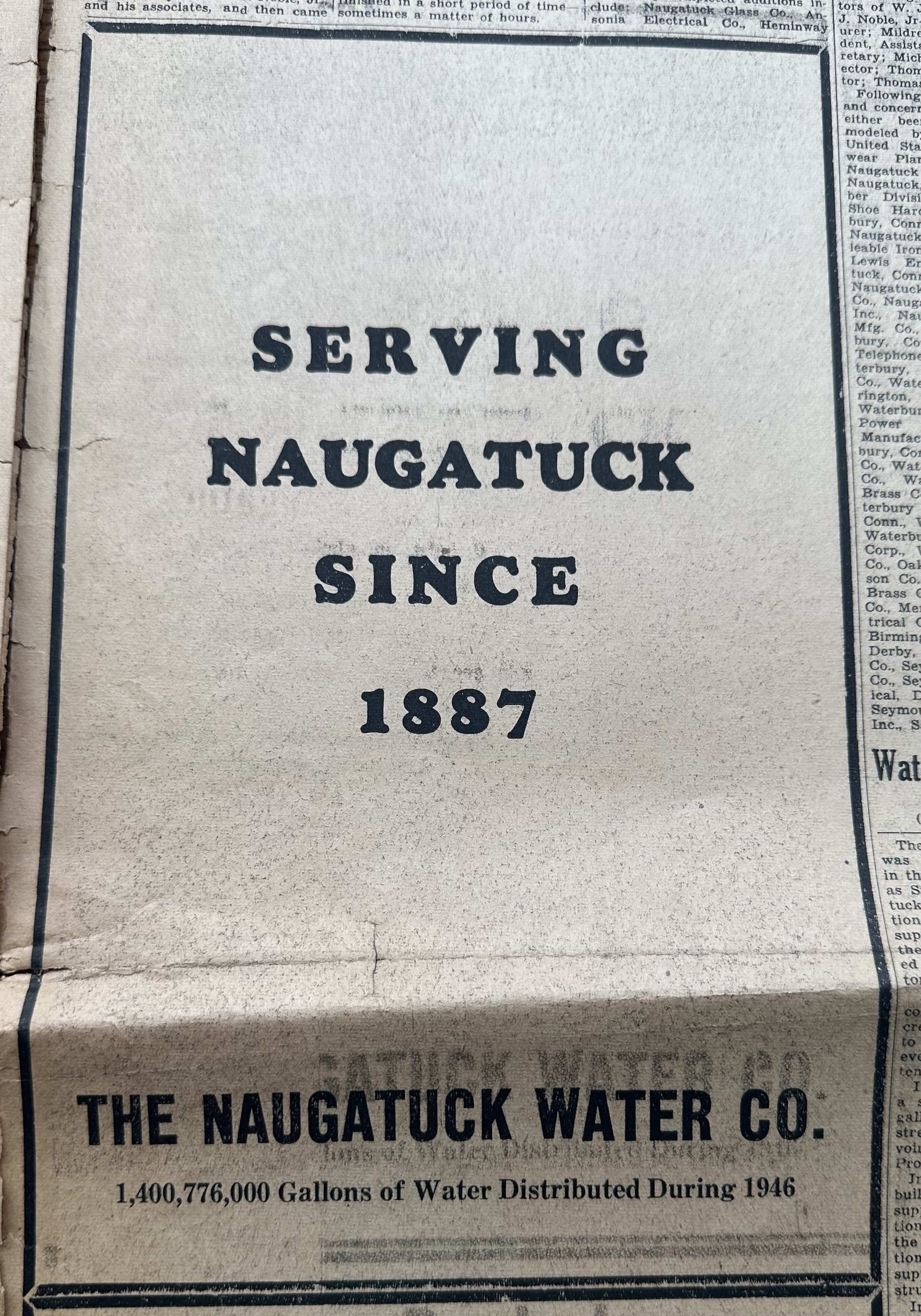
Naugatuck Daily News – Monday, September 15, 1947
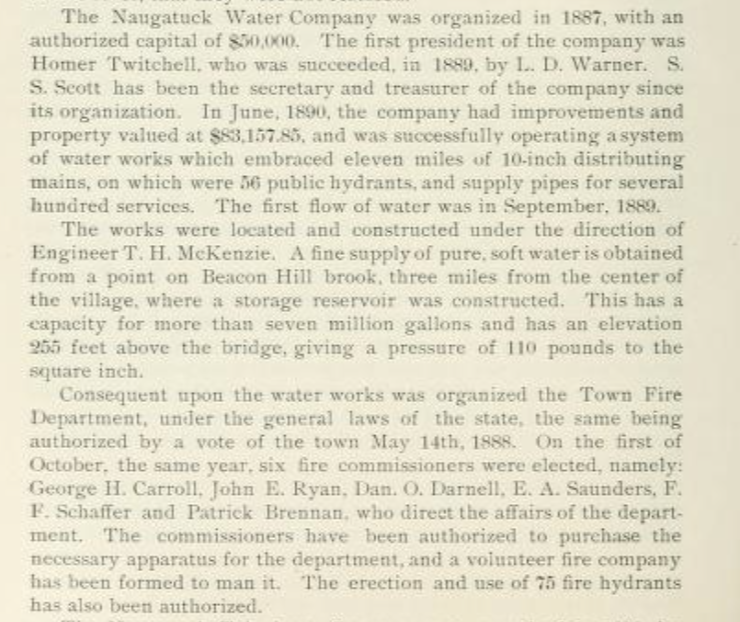
Source: History of New Haven County, Connecticut (p. 718)
Online Research Library