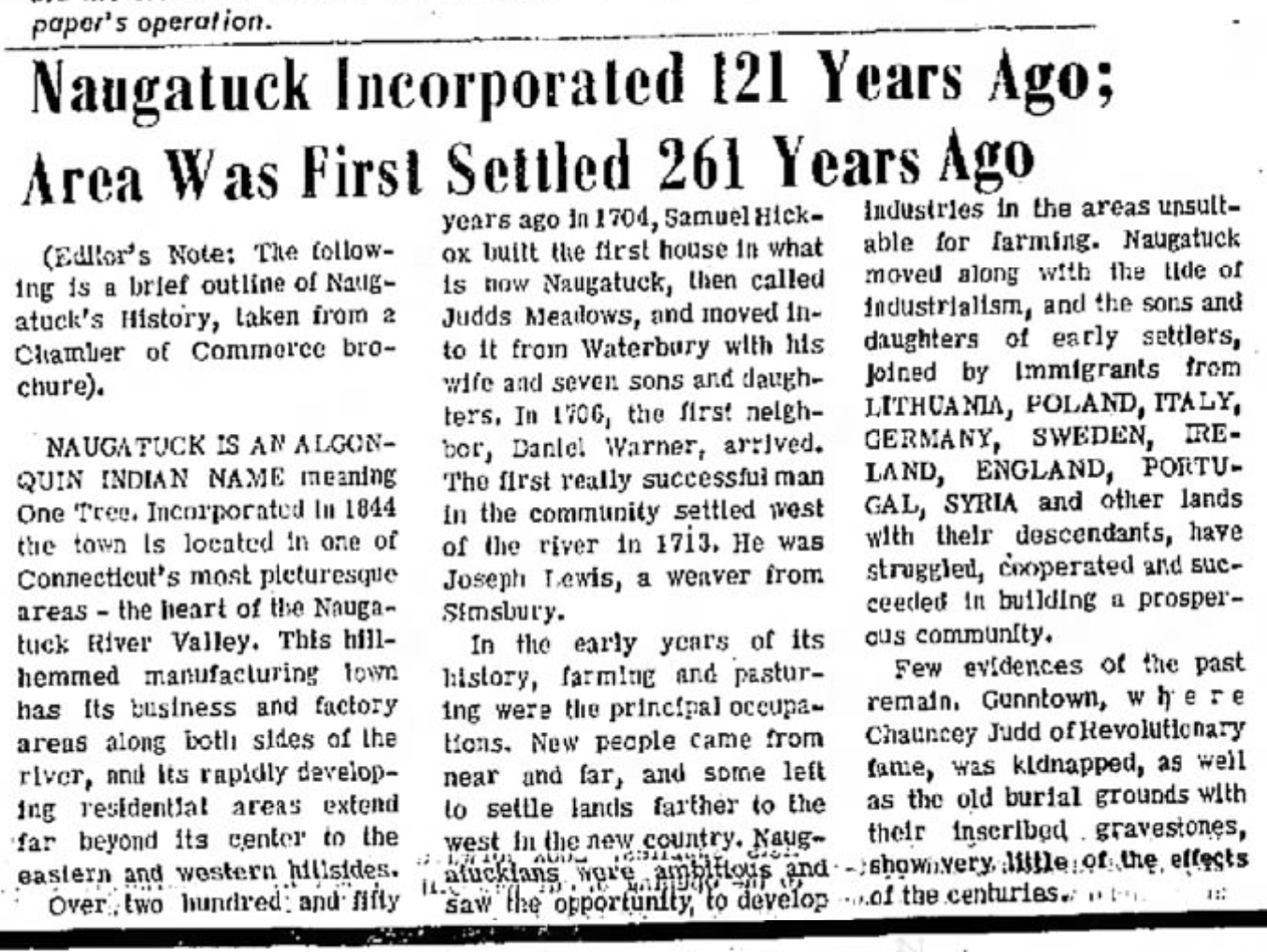
Naugatuck Incorporated
The name ‘Naugatuck’ dates to 1844
‘Naukotunk’ is said to mean ‘one large tree’ in the original Indian form of the word
Like most names in this part of Connecticut, the borough of Naugatuck has its roots in the early days of this community.
Naugatuck was part of Waterbury for more than 170 years before residents of the area petitioned to be recognized as a separate town. For many years Naugatuck’s first unofficial name was “Judd’s Meadows,” after Deacon William Judd was voted the first division of the meadows downstream of what was then Mattatuck (later changed to Waterbury).
Years later, the region around Judd’s land included the land of many other men, who were the first landowners.
Religion played a major part in the reason for the second name change. By 1765, there were enough residents of Judd’s Meadows to hold religious services during the winter nearer their own home, instead of having to travel to Waterbury each Sunday. This “winter privilege” would allow them to have a service in their own community from the first of December to the end of March.
In 1773, a new ecclesiastical society was created and was named the Salem Society. Somewhat later, the region became known as Salem Bridge.
Finally, sometime during the early 1840s, when there were 1,730 residents, a petition was submitted to the General Assembly to form a separate town. A post office had been established in 1844 under the name “Naugatuck,” in deference to the river, and to avoid confusion with Salem, Conn., in Middlesex County.
In the spring of 1844, the General Assembly approved the request, and Naugatuck was incorporated as a distinct town.
Now as to the meaning of the name “Naugatuck,” Dr. Joseph Anderson of
“It appears in the Paugasuck deed as the established designation of the Mattatuck River ... It was once the most widely known of all the aboriginal names in the Valley.
This was offered in Doctor Bronson’s
letter from Stiles French of Northampton, Mass., formerly of Seymour, whose authority was Eunice Mauwee. Mr. French says:
“She (said) that the name Naugatuck meant ‘one big tree’ and was pronounced by the Indians ‘Naw-ka-tunk.’ This ‘old big tree’ stood about where the copper works in Seymour now are, and afforded the Indians a shade when they came to the Rimmon falls to fish.”
For those living in Naugatuck today, or for its visitors, the sight of “one large tree” is reminder enough of the borough’s humble beginnings.
Eileen K. Ehman
Source: Special Edition of the Naugatuck Daily News (1844 - Naugatuck Sesquicentennial - 1944)
Early settlers
A deeply wooded land with a large river traveling through it attracted the earliest settlers to the land now known as Naugatuck.
The rich farming land along the narrows and the large, open fields beyond provided an ideal setting for growing crops and grazing livestock.
In 1673, 26 men were granted land for a new settlement, called Deacon’s Meadows.
Open fields draw earliest settlers in 1673
Picture a deeply wooded land with a large river running through, providing rich farming land along the narrows and large, open fields for grazing beyond.
This was Naugatuck, more than 300 years ago, when it was still unsettled and didn’t have a name of its own. But there were men who saw its potential.
In 1673, 26 men from Farmington filed a petition with the General Court of the colony of Connecticut, seeking the right to plan a new settlement.
The land lay in the southern part of what was first known as Mattatuck and later named Waterbury.
Land allotments granted to these men, not one of whom made his home here:
• William Judd, given a lot called the “Deacon’s Meadow,” owned land where the Great Hill meets the river and extended below the present Maple Street bridge.
• Rev. John Southmayd, given land that begins at the mouth of Hop Brook.
• Abraham Andrews, a lot which includes the site of the Union City railroad station, now gone for many years.
• John Carrington, on Hop Brook.
• John Bronson, on Hop Brook.
• John Welton, on Hop Brook.
• John Judd, located below the Deacon’s Meadow.
• William Higginson, also, below Deacon’s Meadow.
• David Carpenter, whose lot included land on both sides of Long Meadow Brook.
• Joseph Gaylord (including the next four landowners) were south of Deacon’s Meadow Brook.
• John Scoville.
• Edward Scott.
• Thomas Richardson.
• John Langston.
• John Warner, a lot on the east side of the river, beginning at Beacon Hill Brook, followed by the lots of the next eight men.
• Benjamin Jones.
• Samuel Hickox.
• John Warner.
• Samuel Judd.
• Daniel Warner.
• Timothy Standley.
• Benjamin Barnes.
• Thomas Warner.
• Daniel Porter, whose lot ended a bit south of Fulling Mill Brook at the edge of lands previously allotted.
The first home in the region was built by Samuel Hickox, Jr., the son of the original Hickox. In 1702, Hickox was 35 years old when he moved his wife and seven sons and daughters into their new home.
At the time, houses were built before the homeowner owned the land upon which they were built. Hickox was granted eight acres adjacent to Hickox. Hickox is also credited with providing the name for the brook that ran on his land. Fulling Mill Brook received its name because Hickox set up a fulling mill for processing homespun cloth. Fulling was the process of cleaning and shrinking homespun cloth.
The Hickox family was soon joined by a second, Daniel Warner, his wife, and children.
It is also believed that Joseph Lewis settled on the west side of the river somewhere between 1703 and 1713. Lewis gave his name to the large tract of land that came to be the center of Naugatuck.
In the earliest days of the community’s settlement, the area was known as Lewisville.
Most of the early inhabitants used this land to graze their cattle and to farm.
In later years, the land also became valuable for growing rye.
As the region became more populated, settlers plied their trades and shops were established along the river.
The course of Naugatuck history was well on its way.
— Eileen K. Ehman
Source: Special Edition of the Naugatuck Daily News (1844 - Naugatuck Sesquicentennial - 1944)
-
![]()
Naugatuck Daily News - Fri, Oct 29, 1965