
Lyman Bradley & Company
Community Contribution
The first record of organized manufacturing of pocketknives in the United States indicates that Naugatuck was the location of the waterwheel powered factories where they were mass produced. In 1841 Lyman Bradley & Company built a water-powered factory on “The Falls” in the Bradleyville section of Salem, which soon after was renamed Naugatuck in 1844.
In the photos you can see some vintage pocketknives, also called jackknives, with the still clearly visible stamp of the "L Bradley Knife Co." These were undoubtedly made in a former mill on the banks of the Naugatuck River.
“About 1841 Lyman Bradley and George Beecher undertook on a small scale manufacture of pocketknives in an old building at the west end of the bridge in the village center. For this venture Bradley brought over from Sheffield, England, the first foreign workmen to come to Salem. A generation later cutlery was to be one of Naugatuck’s most successful industries.”
Like other early American industries born on the waterways of Naugatuck, L. Bradley Knives were on a course to affect the global market. Previously dominated by European cutlers, events were set into motion in the tiny village of Salem that would relocate the major manufacturing of jackknives, aka pocketknives, from the old world, to the new.
"A 19th-century Connecticut pocketknife was made by skilled craftsmen using tools and equipment that were familiar to English producers. The knives ranged from two to six inches long with one or more hinged blades at one or both ends. The blades were usually forged or blanked from strip steel before being trimmed, hardened, tempered, ground, and cleaned. Metal liners defined its shape and part of the frame, with bolsters attached. The tang, or unsharpened extension of the blade, was attached to the hinge pin of the handle, generally made of bone or wood. The finished knives, once sharpened, then entered distribution. Consumers used them to open various items, prepare food, shape wood, do gardening, and accomplish many other tasks."
In the photos, you will see a vintage illustration detailing the various parts of a jackknife assembled during the manufacturing process.
As mentioned, Bradley employed skilled workers from Sheffield, England, who were attracted by higher wages and steady employment. Sheffield was considered to be the birthplace of knife making and home to its finest craftsmen.
"Sheffield is synonymous with steel and is the historic birthplace of knife making. In Sheffield the word 'cutlery' refers to 'that which cuts.' For more than 700 years, Sheffield knives and cutlery have been created by highly skilled Sheffield craftsmen, and our company names are amongst the most famous in the industry’s history. The first reference to a Sheffield cutler dates to 1297. In the 1370s, Chaucer described a Sheffield 'thwitel' (a straight wooden-handled knife) on the belt of a Miller in The Reeve's Tale."
In 1843 Lyman Bradley also became manager of a Waterville (Waterbury) firm, the Waterville Manufacturing Company which produced pocketknives. Other Connecticut knife manufacturers then started up and entered the market. The Holley Company of Lakeville opened in 1844 and quickly became one of the industry’s largest producers. More factories opened around 1849: the American Knife Company of Plymouth Hollow (later named Thomaston), the Birmingham Knife Works and Clark R. Shelton (both in Derby).
In 1848, Smith & Hopkins opened in Naugatuck, and from 1850-1900 at least twelve more knife companies opened in the Naugatuck Valley. From 1865 to 1885, Union City was one of the most important cutlery centers in the United States.
The Union Knife Company was built in 1851 and the dam and factory were located on the Fulling Milling Brook at the appropriately named Sheffield Lane. The company's specialty was pocketknives.
In 1852 the Naugatuck Machine Company opened. Various machinery was made, in addition to pocketknives.
The Naugatuck Cutlery Company, obviously located in Naugatuck, operated from 1872 to 1888.
According to the Goins Encyclopedia of Cutlery, a few names well-known in Naugatuck entered into the cutlery business during this period. From 1867 to 1883, George A. Lewis, Bronson Tuttle and John H. Whittemore operated one of the largest firms in the area, the Connecticut Cutlery Company. Homer Twitchell, another well-known Naugatuckian managed the firm. In yet another "first" for Naugatuck, Twitchell was awarded a patent in 1864 for an improvement to the design of pocketknives. As seen in the photos, a copy of his patent is still available to view in the archives.
UNITED STATES PATENT OFFICE.
Homer Twitchell, of NAUGATUCK, CONNECTICUT.
IMPROVEMENT IN POCKET-KNIVES.
Specification forming part of Letters Patent No. 42,031 , dated March 522, 1864.
To all whom it may concern,
Be it known that I, Homer Twitchell, of the town of Naugatuck, in the county of New Haven and State of Connecticut, have invented a new and useful improvement in Pocket-Knives...
In the photos, you can see an excerpt from "American Scissors and Shears, By Philip R. Pankiewicz" which not only details the formation of the Connecticut Cutlery Company, but also features an amazing photo of the dam located at the factory, frozen solid in winter!
At this point in history, Connecticut factories had become leaders in the manufacture of pocketknives, dominating the industry in the United States well into the 1940’s.
But even in the market's earliest days, Naugatuck's influence on the jackknife industry extended well beyond the state borders. According to an expert in antique pocket knives, Lyman Bradley also inadvertently gave rise to another business, one of the longest lived pocketknife manufacturers.
Bradley is credited with being the first to entice cutlers from England to bring their skills to America and seek their fortune in the new world, but after the British cutlers had been here a while crafting knives in the Connecticut factory, the government began to increase taxes on many manufacturers. Lyman decided to pass the extra costs on to his cutlers by charging them for any tools they happened to break. Up until this point any needed replacement tools were supplied by the company. The craftsmen who were daring enough to immigrate from England when they became disgruntled with the way the government was treating them there, were certainly not going to stand for any nonsense here, in the land of opportunity.
Sixteen of the British cutlers left Lyman's employ and traveled to the Hudson Valley in New York. They resettled in what was then called Matteawan, later to be called Beacon, and founded the New York Knife Company. Four years later they moved across the Hudson River and built a larger production facility in Walden, New York. Lyman Bradley had caused the birth of what became the largest knife producer in the world. The New York Knife Company remained an industry leader until around the 1930s long after Lyman Bradley’s company was gone.
"The New York Knife Company factory operated for a 75-year period from 1856 to 1931 in the village of Walden. The factory underwent five major expansions that served to modernize and reorganize the production sequence for the manufacturing of jackknives and table cutlery. The expansion of the New York Knife Company's factory was accompanied by an increase in the number of workers, the amount of raw materials used, and the amount of jackknives and table cutlery produced. The New York Knife Company continued to operate until 1931, when it was finally forced to shut down its operation due to the 1929 stock market crash and the Great Depression. The change in size, spatial organization of the factory, and methods of production document the rise of the industrial-era working class through the shift from hand to mass production."
A second company, the Walden Knife Company, sprang from the ranks of the New York Knife Company apparently after a friendly game of lunchtime baseball turned ugly.
"A group of workers left and formed the Walden Knife Company, which was also located in the village, and utilized the water power from the Wallkill River. The split supposedly came about over a baseball game. The workers from the different floors of the New York Knife Company would play each other during lunch. When one of the games resulted in a brawl, Management issued an order that baseball was not to be played at lunch. Several of the employees were either upset with this edict or with the management of the company, and decided to leave and start their own company."
Perhaps it can be said that Lyman Bradley caused the birth of not one, but two new businesses, the Walden Knife Company being sort of a "grandson" company. Europe was no longer home to the leading manufacturers of pocketknives.
In 2000, state and federal agencies sponsored an important archaeological dig at the historic site of the New York Knife Company factory. A wealth of artifacts and significant historical finds were unearthed and catalogued in a report by the New York State Museum.
In the photos you will see some of the over 1,400 artifacts that were unearthed and carefully examined, catalogued and preserved.
"The archaeological testing at the New York Knife Company factory site revealed temporally distinct stratigraphic deposits associated with the expansion of the factory and production of jackknives and table cutlery. The four periods represented in the archaeological record date from 1856 to 1880, 1880 to 1887, 1900 to 1905, and 1905 to 1931. Artifacts associated with the knife manufacturing process, knife parts, architectural artifacts, and domestic artifacts were recovered from all of the periods."
Once again, Naugatuck was the birthing ground for events, inventions and products that would have global impact. Collectible brand names like Schrade, Empire and more, can be traced back to the earliest beginnings at L. Bradley Knife Company in Naugatuck, Connecticut.
"George Schrade left the Walden Knife Company in 1904 and started his own company to manufacture and sell an improved version of the switchblade knife he originally designed for the Walden Knife Company."
Schrade would later move his business to Bridgeport, Connecticut, and having achieved great success, he bought out the Walden Knife Company, where he had previously worked.
Thanks to Naugatuck "firsts" from innovators like Lyman Bradley and Homer Twitchell, people around the world are still using products that are the direct result of a close-knit lineage of skilled cutlers. These craftsmen got their start in the factories on the rivers and streams of Naugatuck, and the offshoot companies that were founded in the years to come.
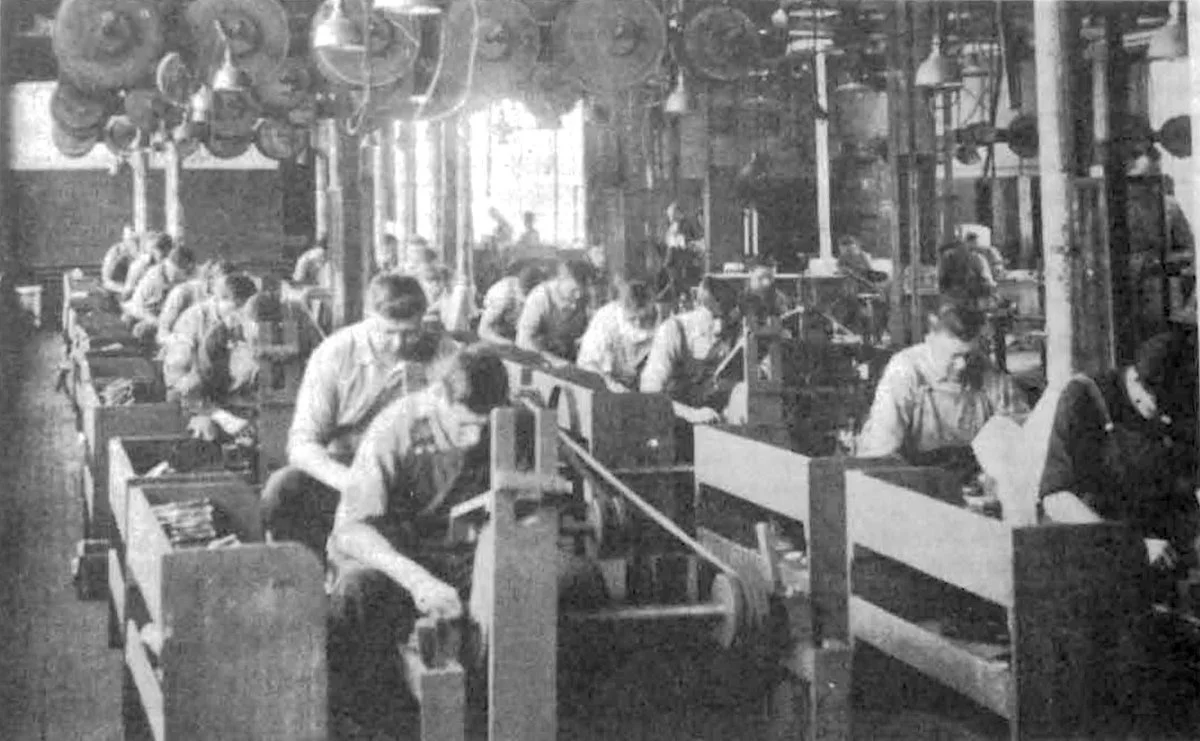
An early twentieth century photo of a grinding room in a knife factory most likely located on the Naugatuck River or one of the streams that feed into it.
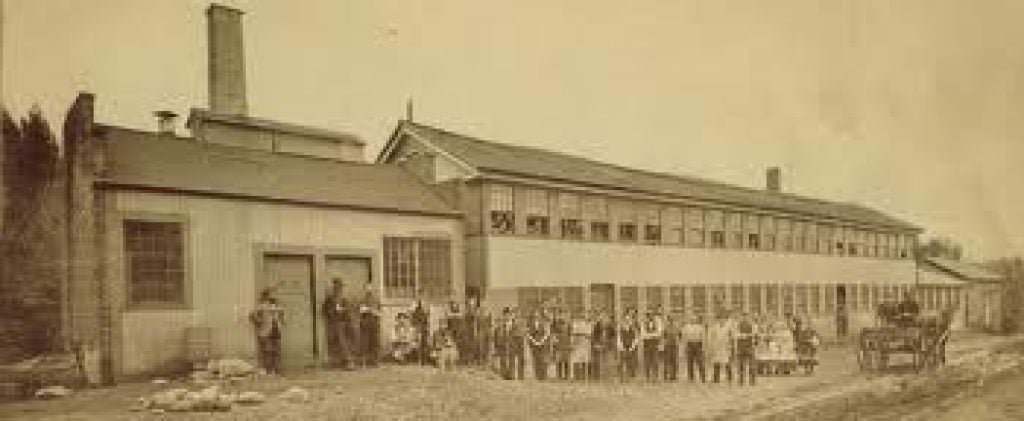
The Union Knife Company in Naugatuck, CT. Knives featuring their imprint on the tang are highly prized collectibles in today's thriving antique pocketknife market.
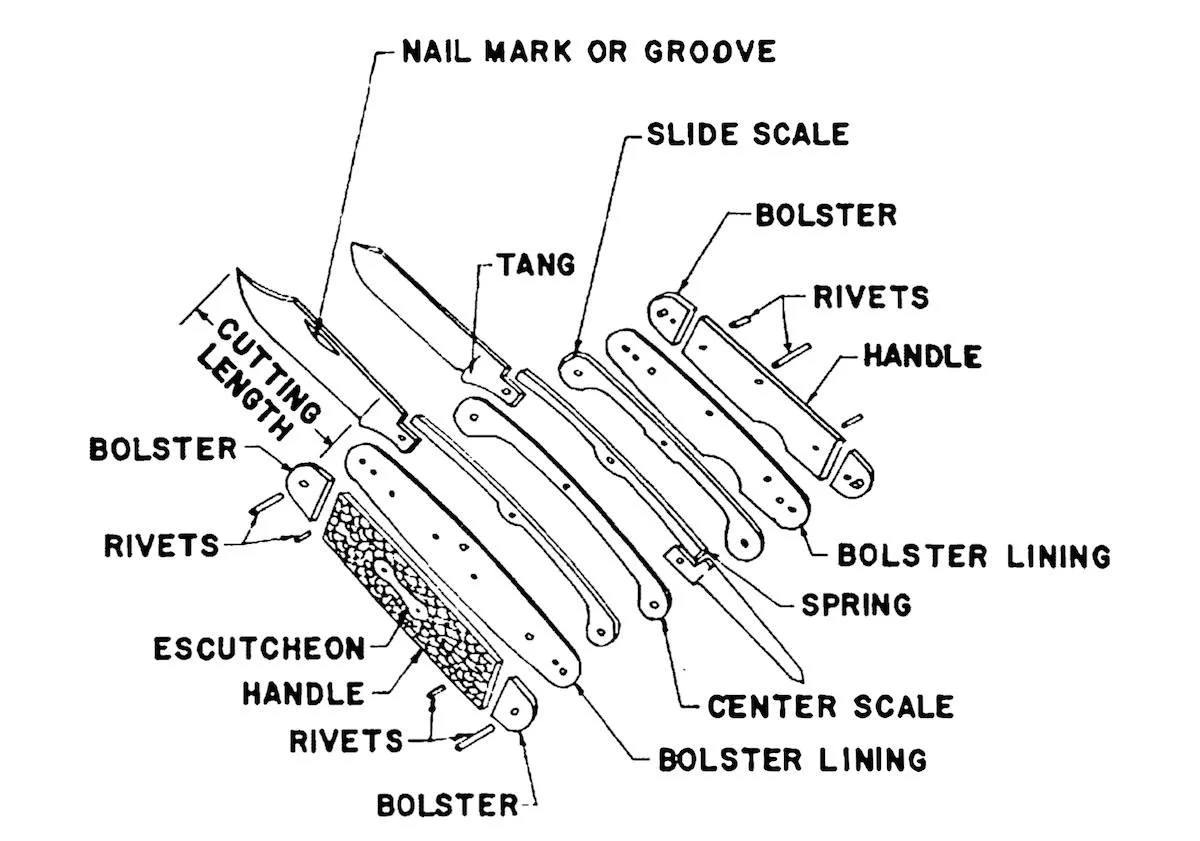
This vintage illustration details the various parts of a jackknife assembled during the manufacturing process.
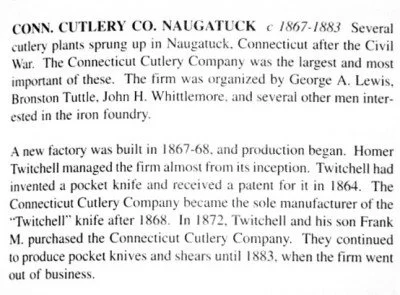
According to this excerpt from the Goins Encyclopedia of Cutlery, a few names well-known in Naugatuck entered into the cutlery business during the period from 1867 to 1883. George A. Lewis, Bronson Tuttle and John H. Whittemore operated one of the largest firms in the area, the Connecticut Cutlery Company. Homer Twitchell, another well-known Naugatuckian managed the firm. In yet another "first" for Naugatuck, Twitchell was awarded a patent in 1864 for an improvement to the design of pocketknives.
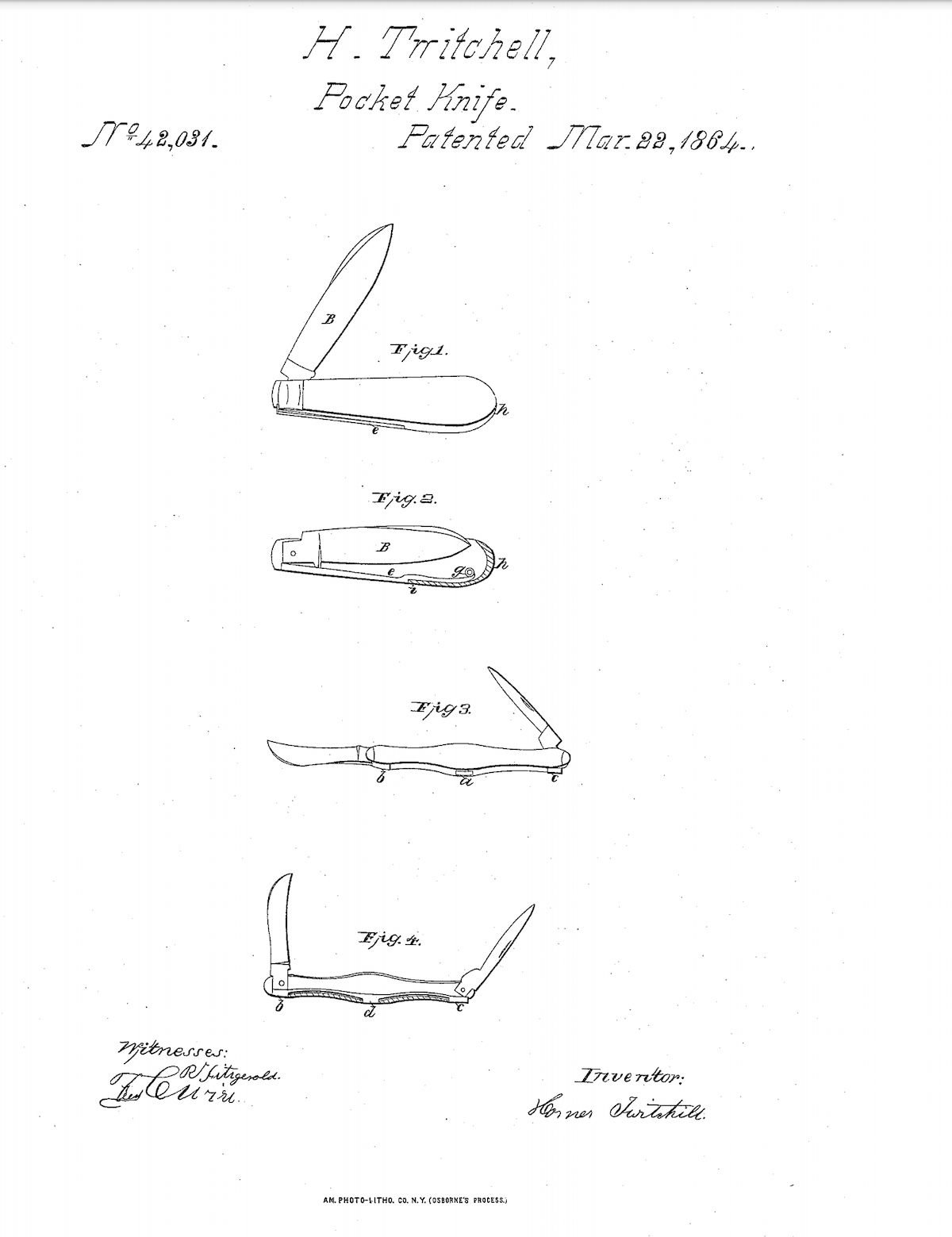
In yet another "first" for Naugatuck, Homer Twitchell, a well-known name in Naugatuck, was awarded a patent in 1864 for an improvement to the design of pocketknives.
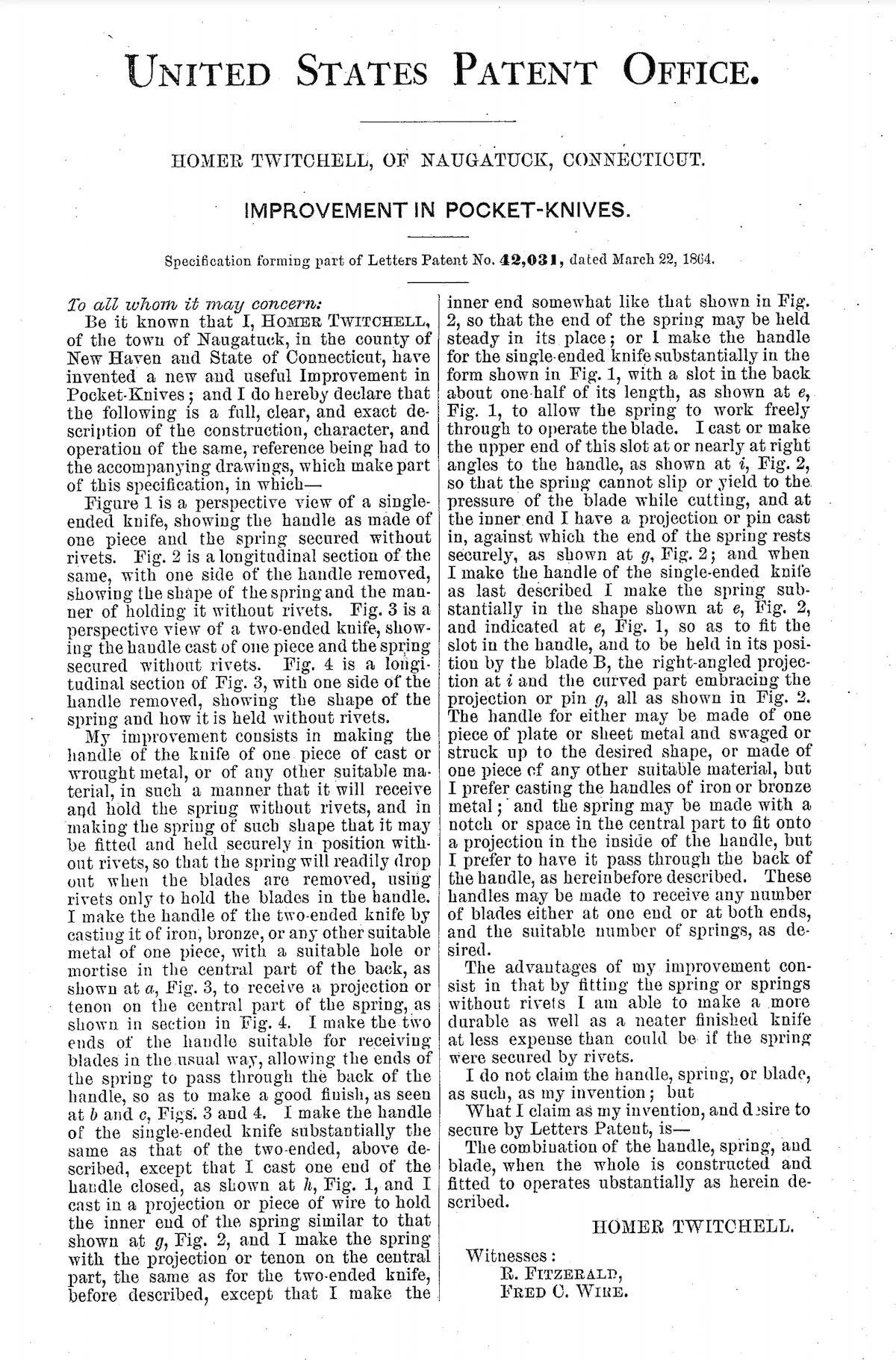
In yet another "first" for Naugatuck, Homer Twitchell, a well-known name in Naugatuck, was awarded a patent in 1864 for an improvement to the design of pocketknives. The second page of his patent explains his improvement in great detail.
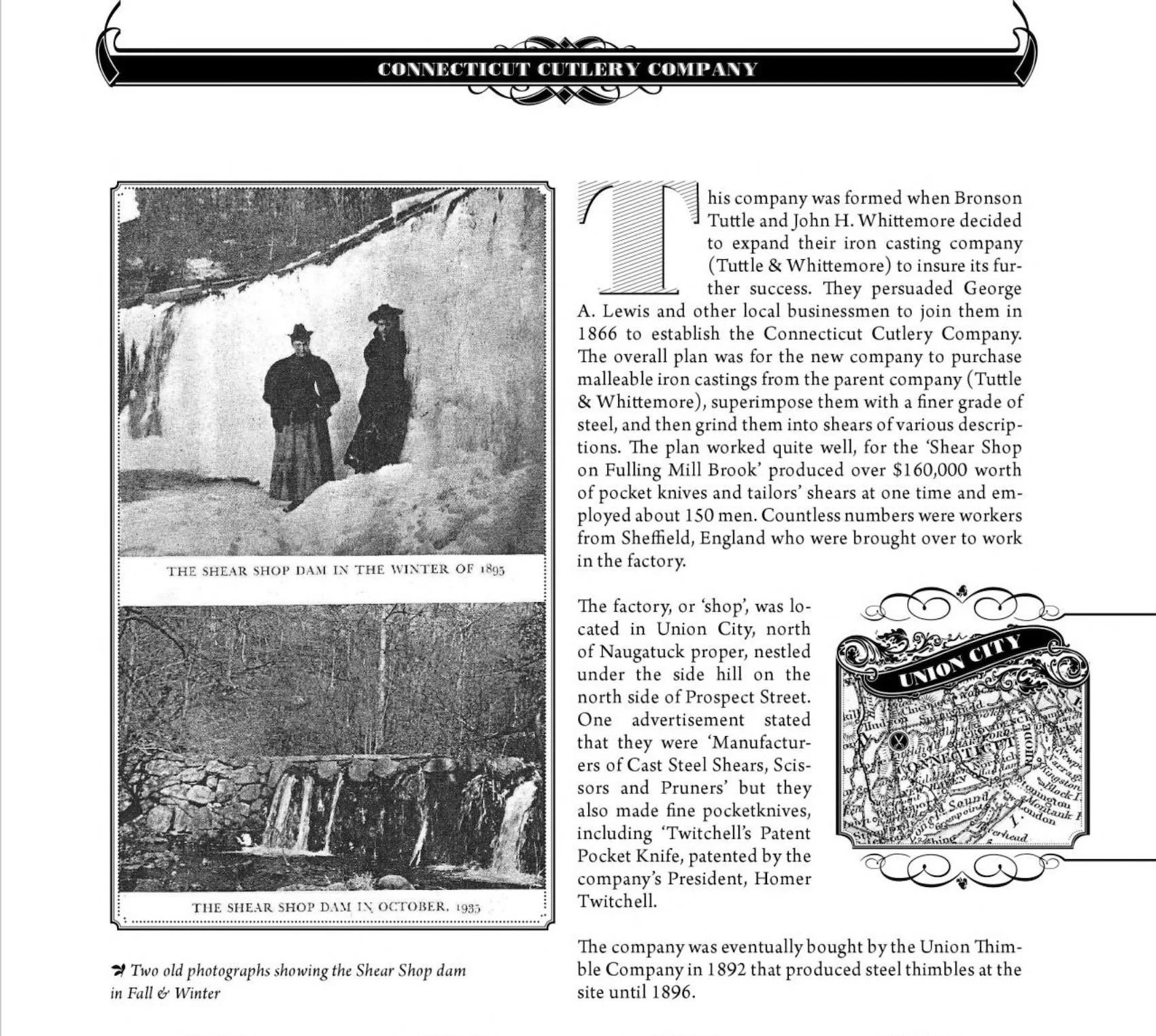
This excerpt from "American Scissors and Shears, By Philip R. Pankiewicz" not only details the formation of the Connecticut Cutlery Company in Union City, but also features an amazing photo of the dam located at the factory, frozen solid in winter! A second photo shows the waters of the Fulling Mill Brook flowing freely.
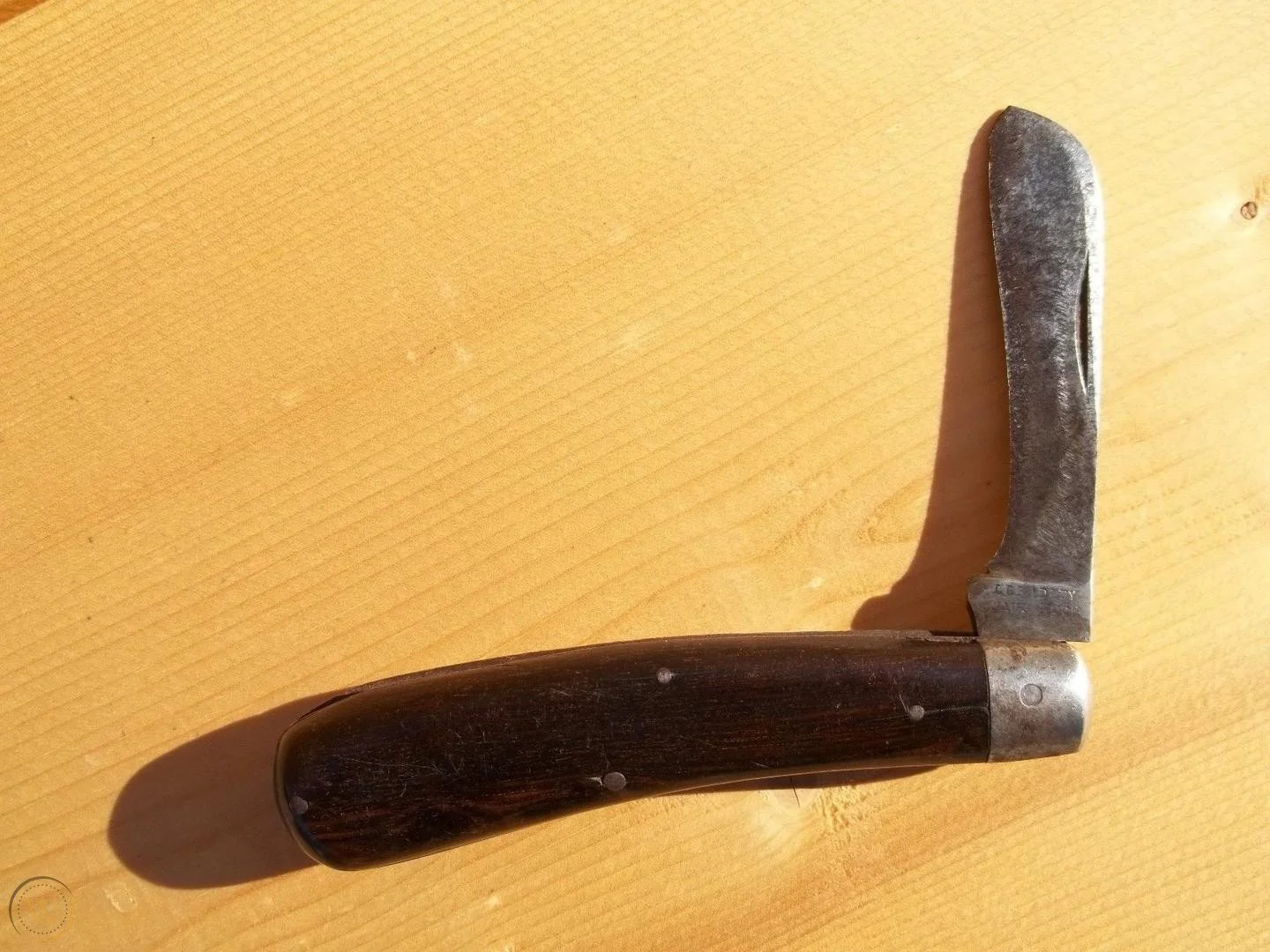
An antique jackknife manufactured by L. Bradley Knife Company in Naugatuck, CT. The stamp is still visible on the tang.
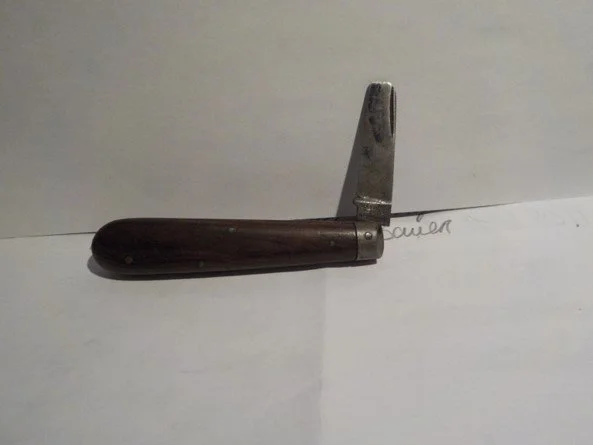
Another antique jackknife manufactured by L. Bradley Knife Company in Naugatuck, CT. The stamp is still visible on the tang.
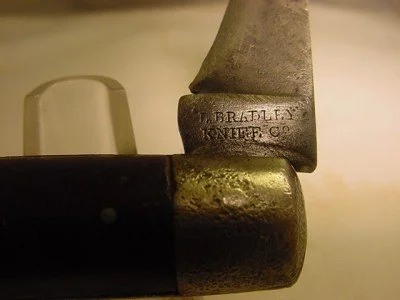
Another antique jackknife manufactured by L. Bradley Knife Company in Naugatuck, CT. The stamp is still visible on the tang.
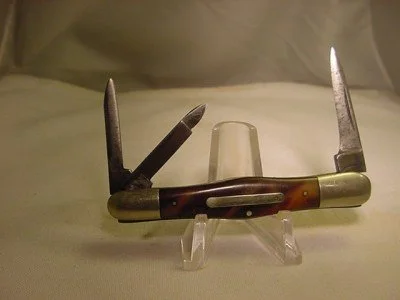
An antique pocketknife manufactured by the Union Knife Company in Naugatuck, CT. The stamp is still visible on the tang.
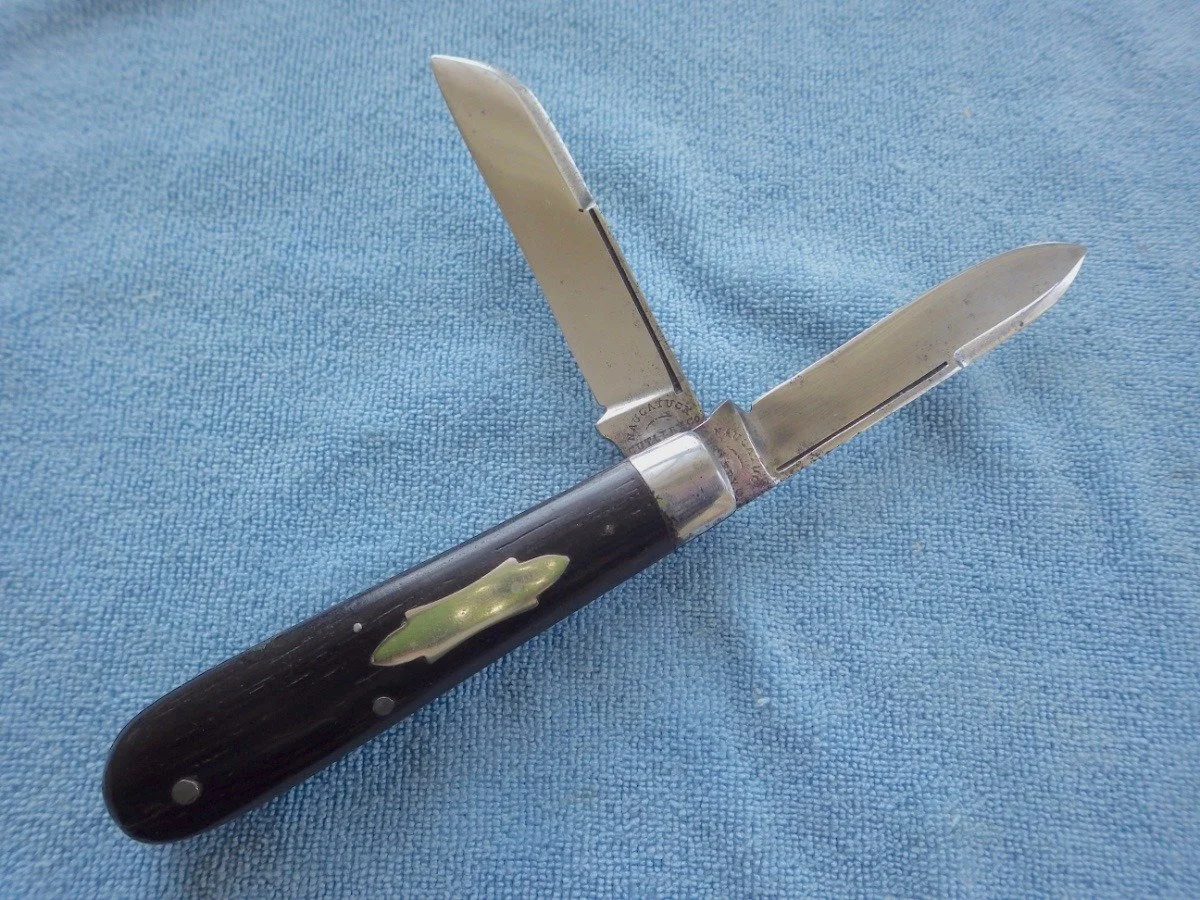
An antique pocketknife manufactured by the Naugatuck Cutlery Company in Naugatuck, CT. The stamp is still clearly visible on the tang.
Walden, NY: The New York Knife Company factory's south side and the Walden Knife Works in the inset. These companies became world leaders in the pocketknife industry, and they might never have been founded if not for Lyman Bradley and his Naugatuck knife factory.

Online Research Library