
People of Naugatuck
Harris Whittemore
Source: Hidden In Plain Sight - The Whittemore Collection and the French Impressionists
Education + Exposure to Art
Arthur Harris Whittemore, called Harry as a child and Harris as an adult, attended Naugatuck public schools until the age of fourteen, when his father sent him to the Greylock Institute for Boys, a prestigious private school in South Williamstown, Massachusetts. School reports and Harris’s letters home indicate that he was a willing student whose best subject in school was music. He studied arithmetic and played baseball, but he loved his guitar.
In the summer of 1880, when Harris was sixteen, he traveled to Europe for two years of further study under the Reverend Isaac Jennings, who had been head of the English and Classical School in Waterbury. Professor Jennings’s group of travelers included Howard Tuttle, the son of J. H. Whittemore’s business partner, and Frederick Chase, whose family owned a successful brass mill in Waterbury. The group spent much of its time in a rented home in Munich, where Harris studied Latin and algebra with Jennings and German with a local tutor. Although Harris also undertook music and piano lessons, Jennings reported to J. H. that Harris enjoyed music but did not want “to work hard enough to play himself.” Jennings and the students toured Europe on study breaks, and Harris also traveled with his parents when they visited in the summer of 1881. With Jennings, Harris toured in Italy, Spain, Gibraltar, Paris, London, and Scotland, visiting the galleries, museums, and cultural landmarks in each city. While in Munich, he spent half his monthly allowance on tickets to the opera, often attending two or three times a week and one time walking four miles only to find that a performance had been postponed. He escorted Johanna Meta, an American singer in the Munich opera, to a Hungarian masked ball, following her performance in Mozart’s Don Juan. His standards for artistic excellence were elevated by such experiences, which also colored his memories of the music at home. In a letter to his parents, he wrote teasingly, “I suppose [the organist at the church in Naugatuck] still fills the church with his melodious steam whistle.”
There is no record that Harris saw works by the Impressionist painters during this first European sojourn, but studying abroad gave him the foundation for his lifetime of collecting. He learned about the Old Masters, was encouraged to buy “objets d’art” from galleries, under the watchful eye of his tutor and ever mindful of his father’s concerns about cost and value, and was introduced to the lively studio of a contemporary artist.
First Gifts
It was at the Uffizi, in Florence, and the Louvre, in Paris, where he immersed himself in the Old Masters, and he spent a two-week convalescence reading an instructional text on the most highly regarded artworks in European collections. He bought gifts for his family at home in various galleries that offered a fashionable mixture of art and antiquities for traveling Americans. He selected lace, gloves, and fans that pleased his mother and aunt and bought gifts that charmed his younger brother and sister as well. He also acquired art objects, “an immense ancient vase, a box of alabasters and a pair of ancient candlesticks” that he shipped home to Naugatuck in June of 1881.
Contemporary Art & Professor Feedback
On this tour Harris was introduced to the world of contemporary artists. While in Munich, his parents commissioned a painting from “Herr Flügen,” probably Joseph Flügen (1842–1906), a German genre painter. Visiting the painter’s studio while the commission was underway, Harris was able to experience the social vitality and economic risks of the artist’s world. The Flügen painting, Der Wilderer, depicted a hunter telling tales to a serving girl in a busy inn. Jennings warned the senior Whittemores, “Do not…allow your expectations to get too high, for while it is a thoroughly fine $800 painting, it is not a $5,000 one.” Undeterred by Jennings’s criticism, the Whittemores liked the painting well enough, and it hung prominently in the living room in their new house in 1890.
At the end of the two-year course abroad, Professor Jennings wrote to J. H. Whittemore about Harris’s aptitude for further academic study and for business: “While he used to have little idea of the value of money, he is sharp at a bargain and has an eye to the main chance [and is] very close mouthed…thoroughly independent of others in his own actions, [and] very persistent in anything he undertakes of his own accord.” Jennings recommended that when young Whittemore returned home, the family—rather than sending him to the general college course—should engage a Yale professor to tutor Harris in history, to add to his eclectic education. For his part, Harris hoped to avoid going back to Greylock.
When Harris returned to the United States, in 1882, the family rented a home in New Haven so that they could participate in the cultural activities available in the city. Perhaps Harris was tutored in history there as well, as Jennings had suggested. In the fall of 1883, he enrolled at Phillips Academy, in Andover, Massachusetts, joining the class of ’84. Although he was expected to take the entrance exams for Yale after his preparation in Andover, there is no record that he entered the college.
Not So Great Work & Relationship to Pope’s
In the fall of 1885, he began entry-level work for his father’s colleague Alfred A. Pope at the Cleveland Malleable Iron Company, and shared a room with George Shepard, a young relative of the Popes, in a home near their fashionable new residence on Euclid Avenue. The Popes included Harris in their evening social activities, as if he were a family member, and brought him with them on their frequent visits to New York City for evenings at the theater or the opera. Indeed, the relationship between the two families was extremely close, with the senior Whittemores and the Popes traveling together to various resorts in the northeast and sharing holidays in each other’s homes. Mrs. Whittemore spent a lengthy convalescence at the Popes’ Cleveland home in 1886, while her son Howard was being treated at a sanitarium in Hot Springs, Arkansas.
In spite of the cordial relations, Harris was not enthusiastic about his work in Cleveland, chafing at the clerical nature of his duties and his low status in the office, as he indicated in letters to his parents at home.
I get so tired of this infernal answering the telephone, filling inkbottles, etc. I cannot reconcile myself to think this is business…
It seems as though I am not learning as much as I ought yet I am straining every nerve. Why is it? I can’t hardly believe that it is lack of work for it seems as though I earn my fifty cents by Eleven o’clock every morning. Howard says to rise above the petty annoyances of business. That is all very well, but I can’t do it. When some days, I get so disgusted with the whole thing that it seems as though I would have to swear at someone. I like to know how a fellow is expected to “rise” when the whole thing is an annoyance more than half the time.
By all of this ranting I don’t want to have you think that I am dissatisfied for I am not. But when some fifteen year old clerk orders you to fill his ink bottle or to black his boots, I confess it makes me a little mad some days, and particularly if he happens to be some cheap fellow, whom you have no respect for and whom you know is bad morally and selfish in all his doings.
Within months, Harris was given more responsibility, working on correspondence and payroll and eventually taking on a larger role in managing production and operations. Nevertheless, he did not want to follow Pope’s example, as he observed in a letter to his parents that the older man’s pace of work would exact a “penalty” down the road. “I am going to take heed and guard against that. I grow to think that a fair position with a salary is better than such a load as Mr. Pope’s with 52 days of rest in a year and barely that.” Whereas his father hoped the apprenticeship in Cleveland would train Harris in the ways of business, Harris—as a result of the apprenticeship—hoped his life would provide him with useful and productive work but also plenty of opportunity to enjoy all that the world offered.
Harris & Theodate Pope Relationship
In the fall of 1888, Harris traveled with the Popes to Europe, intending to stay through to the following spring, when they would visit the much anticipated international fair in Paris. The Popes’ daughter, Theodate (1867–1946), and Alfred’s sister-in-law were also part of the group, which, beginning its tour in Paris, made the usual rounds for American travelers: the Louvre, the Panthéon, Notre Dame, and the Luxembourg gardens. The group also looked in on private art collections, making visits to the Secretan collection of established French artists of the mid-century, which was to be auctioned the following summer, and to the personal collection of the dealer Durand-Ruel, who specialized in both Barbizon paintings and the new work of the Impressionists. They toured Spain and Italy, escorted by travel guides, and attended lectures on the significant attractions in Rome.
While Harris’s friendship with A. A. Pope was growing closer, his relationship with Theodate, with whom he’d become good friends in Cleveland, faltered. With the approval of all the parents, Harris had proposed to Theodate, who was, after months of indecision, disinclined to marry. Dejected, Harris left the Popes in January to travel on his own, revisiting Munich and taking an adventurous trip to St. Petersburg. Returning to Paris by way of Amsterdam, Antwerp, and Brussels, he visited the Salon and the fair in Paris before sailing back to New York in the late spring.
Harris continued to work for Pope for several years, but his base of operations and his attention returned to Naugatuck. Pope nevertheless tried to hire Harris to run the operation in Indianapolis, writing, “If Naugatuck outbids us for your services we will raise the bid and we will raise it now or anytime hereafter at your suggestion. Will you seriously think of coming?” Harris, however, remained in Naugatuck, gradually assuming greater responsibility at the Naugatuck Malleable Iron Company until, ultimately, taking full charge.
Marriage
In the spring of 1891, Harris met Justine Morgan Brockway (1866–1940), who was visiting her sister, the wife of a Naugatuck physician, and whose family was active in New York commercial and political circles. Her grandfather Andrew Morgan had been in the glass business and was an associate of the abolitionist newspaper editor Horace Greeley. Engaged to Harris the following spring, Justine, whose parents were no longer living, was staying in the Bergin Point, New Jersey, home of a Reverend Mr. Jones.
In a ceremony to which the whole town was invited, Justine and Harris were married on September 21, 1892, in the white frame Congregational church on the Naugatuck green. The church was filled with ferns and white roses, and green shades were made to cover the windows so that the new electric lights would cast a glow over the late-afternoon service. Receptions followed in tents set up at Justine’s sister’s home and at the Whittemores’ new home just north of the church. Justine’s family came in from New York and Boston in a private parlor car and made much of the diamond pendant Harris had given his bride.
Building Own Life
In January, the couple sailed for an extended European honeymoon, visiting Italy, Germany, France, and England before returning home in June. In Naugatuck, they lived in the home of the senior Whittemores, where they remained until after the birth of their first two children, Harris Jr., born in 1894, and Helen, born in 1897. In 1898, they moved to a nearby house on Church Street and began planning the construction of their own home, next door to Harris’s parents. The new house was completed in 1901, on land transferred to Harris on his birthday that year. A third child, Gertrude (later known as Tinky), was born in 1903. The new household also included a governess, a cook, a laundress, and a maid.
Business & Trouble to Sustain
Harris was named president of the Naugatuck Malleable Iron Company in 1899, an office he held for the next twenty-five years, overseeing the transformation of the company to meet the demands of the twentieth century. In spite of his youthful goal of gaining respectable work that wouldn’t require too much effort, he led the company as it faced the challenge of finding and supplying modern markets. Nationally, steel began to replace malleable iron in a number of products, and the struggle among iron manufacturers intensified in 1902 when a group of former competitors joined forces to create a large conglomerate, the National Malleable Iron Company. The Cleveland and Naugatuck companies remained independent, with the Naugatuck operation—which already controlled iron foundries in Bridgeport and New Britain, Connecticut—acquiring facilities in Troy, New York, and Wilmington, Delaware, just after the turn of the century. The expanded business was incorporated as the Eastern Malleable Iron Company in 1912, headquartered in Naugatuck, about a mile north of the Whittemore homes.
World War I Disturbance
Business was disrupted during World War I, when the company converted its production lines to make castings for hand and rifle grenades. At the same time, the company built a variety of recreational facilities for the newly expanded and largely immigrant work force, and established a research laboratory, replacing traditional manufacturing methods with technologies based on scientific process.
Public Affairs
His business judgment highly regarded, Harris served on a number of corporate boards in the state, advising companies involved in manufacturing, insurance, finance, and utilities. He succeeded his father on the boards of both the New York, New Haven & Hartford Railroad and Pope’s company in Cleveland. The publisher of the Waterbury paper credited Harris with negotiating the merger of that city’s brass companies with Montana-based Anaconda in 1922, which at the time was one of the largest mergers in corporate history. While it transferred control of the region’s leading industry away from local owners, community leaders hoped the deal would stabilize the brass business during its painful adjustment to a peacetime economy following World War I. As had his father before him, Harris also served as president of the Waterbury Hospital and of Colonial Trust, commissioned and built a school and donated it to the town of Naugatuck, and took a lead role in organizations that provided essential community services—for instance, by donating land and funds for the new Naugatuck YMCA building. In addition, he guided the establishment of private schools in Middlebury and Avon, developed the residential neighborhood at Rockwell Avenue and Salem Street on the northwest side of Naugatuck, between his home and the factory, and gave a home to the Naugatuck Day Nursery. He was also the executive of the Naugatuck Red Cross.
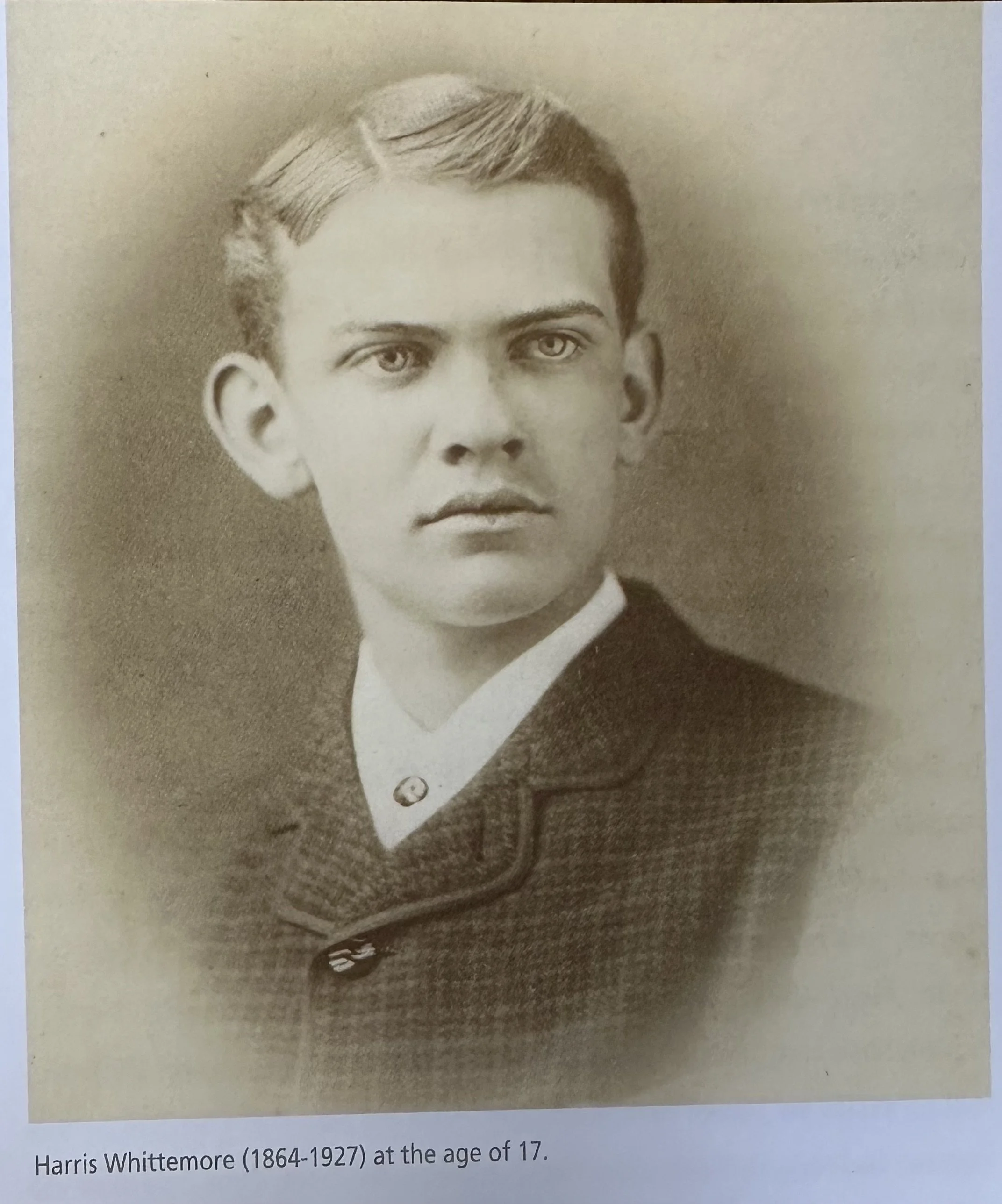
Source: Hidden In Plain Sight
Naugatuck State Forest & Land Protection/Restoration
Harris continued his father’s work to protect and restore the region’s landscape, which was threatened by expanding industries and urban growth. In 1911, the National Congress of the Daughters of the American Revolution recognized Harris for planting 200,000 trees in Middlebury and Woodbury along the western side of Lake Quassapaug, on land that is now part of the Whittemore Sanctuary at Woodbury’s Flanders Nature Center. He became a founding member, and later president, of the Connecticut Forest and Park Commission in the inaugural years of its statewide conservation efforts. In 1921, he began to purchase land along both sides of the Naugatuck River south of town, eventually planting 150,000 trees on the east side of the river and 75,000 trees on the west. In 1931, his heirs donated 2,000 newly planted acres there to the state, establishing the Naugatuck State Forest. Elsewhere, in 1923, he purchased 340 acres of seashore along Long Island Sound at Meigs Point, next to the state’s then-new park at Hammonasset Beach. Protecting it from imminent development, he held the waterfront land for two years until the state allocated the funds to buy it to expand the park. In honor of his conservation efforts, family members later donated land and funds to create Kettletown State Park in Southbury and People’s State Forest in Riverton, both in Connecticut, and the Whittemore Grove in the redwood forest of Humboldt County, California.
Charitable Giving
Harris’s range of charitable giving was extensive, with annual contributions to hundreds of deserving local organizations as well as to educational and cultural organizations across the country. Some donations were larger than others, such as his gift of a $14,000 organ to the Naugatuck Congregational Church in 1908.
At last, the “melodious steam whistle” was gone. Other gifts were private, made quietly to people in need in Naugatuck and other nearby communities.
Source: Hidden In Plain Sight
Personal Hobbies
Harris and his wife hosted musicales in their Naugatuck home, with as many as 140 guests, and invited friends to more-informal bridge parties. They traveled to New York every Saturday, during the season, for the opera. Harris competed in statewide tennis tournaments and was an avid golfer, taking an active role in the development of the public golf links in Naugatuck, now the municipal course at Hop Brook, and becoming an early member of the Waterbury Country Club. After the war, he joined several elite gentlemen’s clubs in New York whose members were prominent in the world of arts and letters, including the Century Association and the Grolier Club, as well as those whose members shared an interest in public affairs, such as the City Club.
Harris and Justine also traveled extensively, visiting the Columbian Exposition in Chicago in the fall of 1893 and spending long winter holidays in Florida and California. Harris accompanied his mother, sister, and wife to the west coast in 1906, and returned to California.
Harris Whittemore & Theodate Pope - Hop Brook School
Self-taught and one of the country’s first female architects, Theodate would design her parents’ home, Hill-Stead, in Farmington and The Westover School in Middlebury.
In 1914 Harris Whittemore asked Theodate to design the new Union City School (later renamed Hop Brook) for the children of foreign laborers in the Union City section of Naugatuck. The school was unique with its separate kindergarten cottage, fireplaces and a playful “ABC” motif that was repeated throughout the building. Hop Brook welcomed its first class on September 6th, 1916.
Rockwell Avenue - Harris Whittemore Memorial
After Mr. Whittemore’s death, the residents of Rockwell Ave. and Salem St. created a monument with a bronze tablet in honor of Mr. Whittemore for his efforts to beautify Naugatuck. The monument and the pin oak tree remind us of Mr. Whittemore’s generosity to his community.
In 1904 Charles Berger, who was active in the Eastern Malleable Iron Co., conceived a plan of development for the open area between Hillside Ave. and Salem St. Mr. Berger, intent on making a very attractive street, made sure that grass was planted between the road and the sidewalks. He had sugar maples planted along the sidewalks.
Harris Whittemore Sr. recommended that a beautiful pin oak tree be planted at the center triangle. After Mr. Whittemore died, the residents of Rockwell Avenue and Salem Street created a monument with a bronze tablet to honor his efforts to beautify Naugatuck.
Rockwell Avenue became known as a superior residential street.
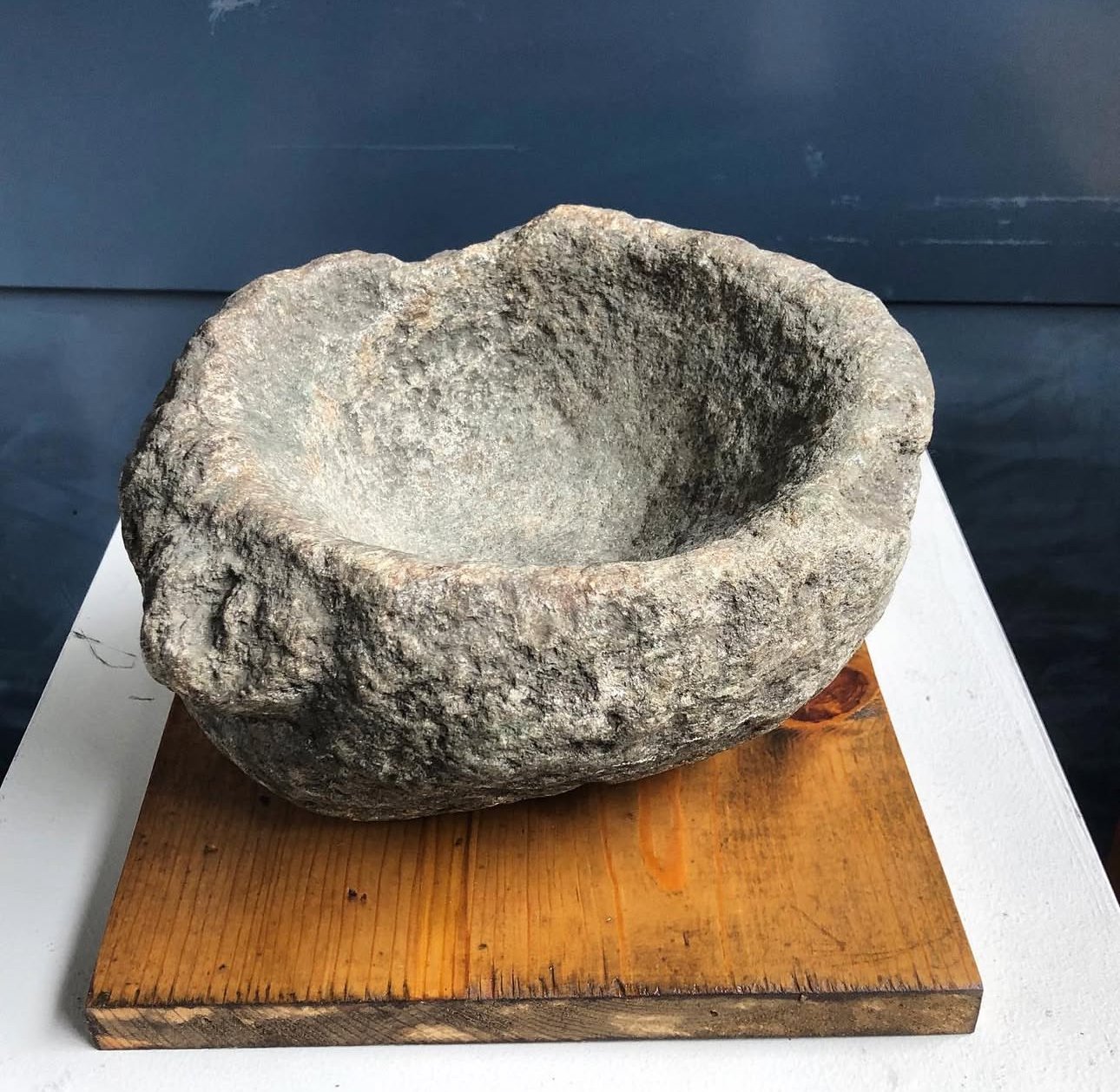
A stone pestle, presumed to be Native American in origin. Donated by Harris Whittemore Jr., October 1964
Source: Hidden In Plain Sight
Death
By 1926, Harris knew that, like his mother and brother, he had a weak heart. On November 29 of the following year, he died at home after suffering a heart attack, four days after his sixty-third birthday.
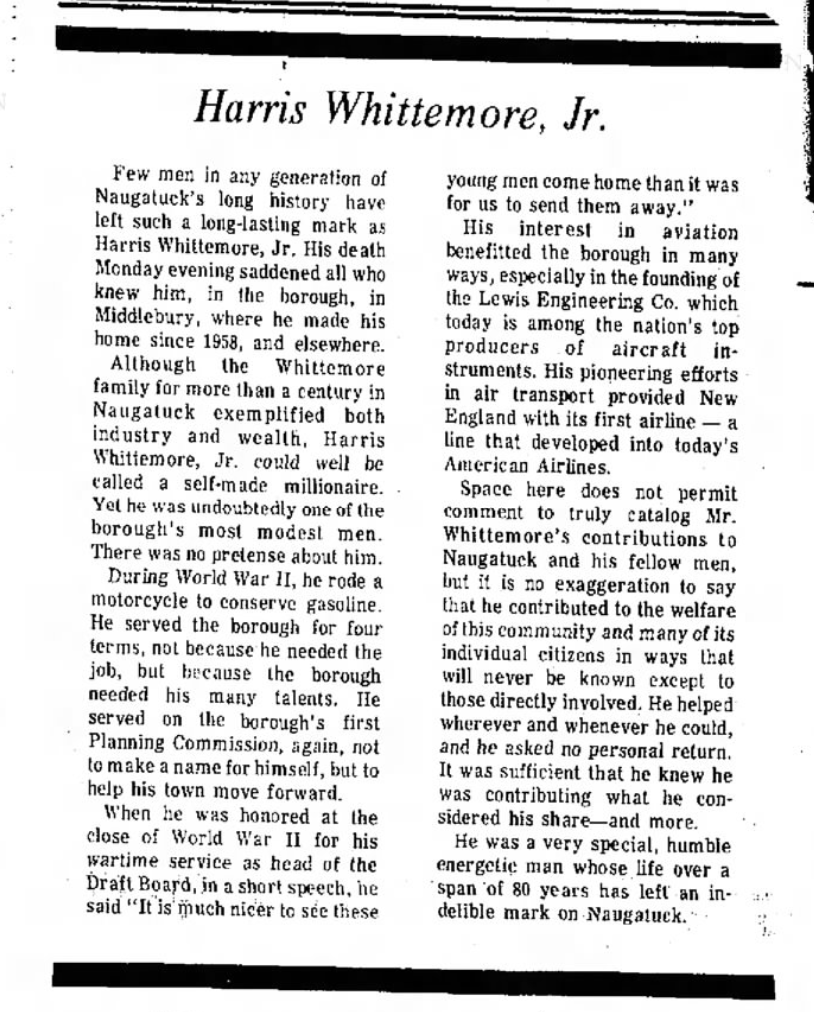
Naugatuck Daily News - Wed, Jun 19, 1974
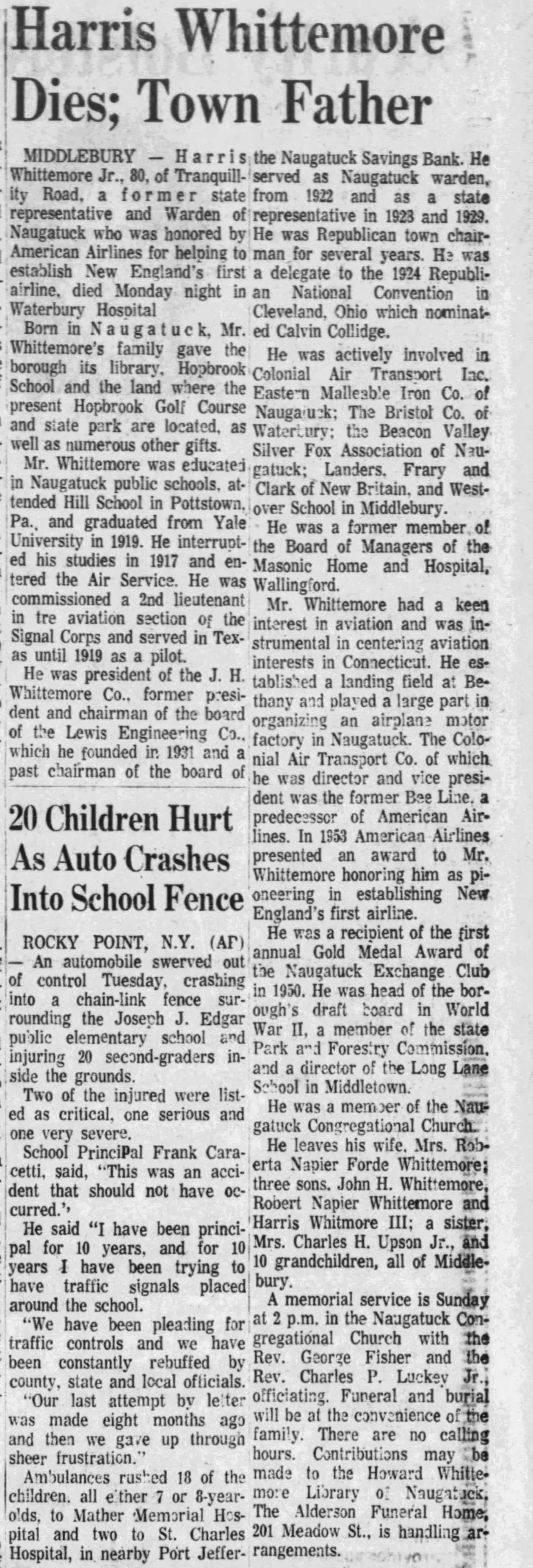
Hartford Courant - Wed, Jun 19, 1974
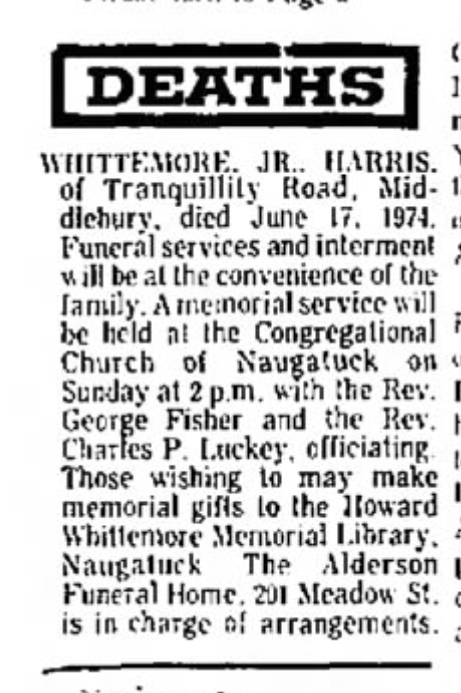
Naugatuck Daily News - Tue, Jun 18, 1974
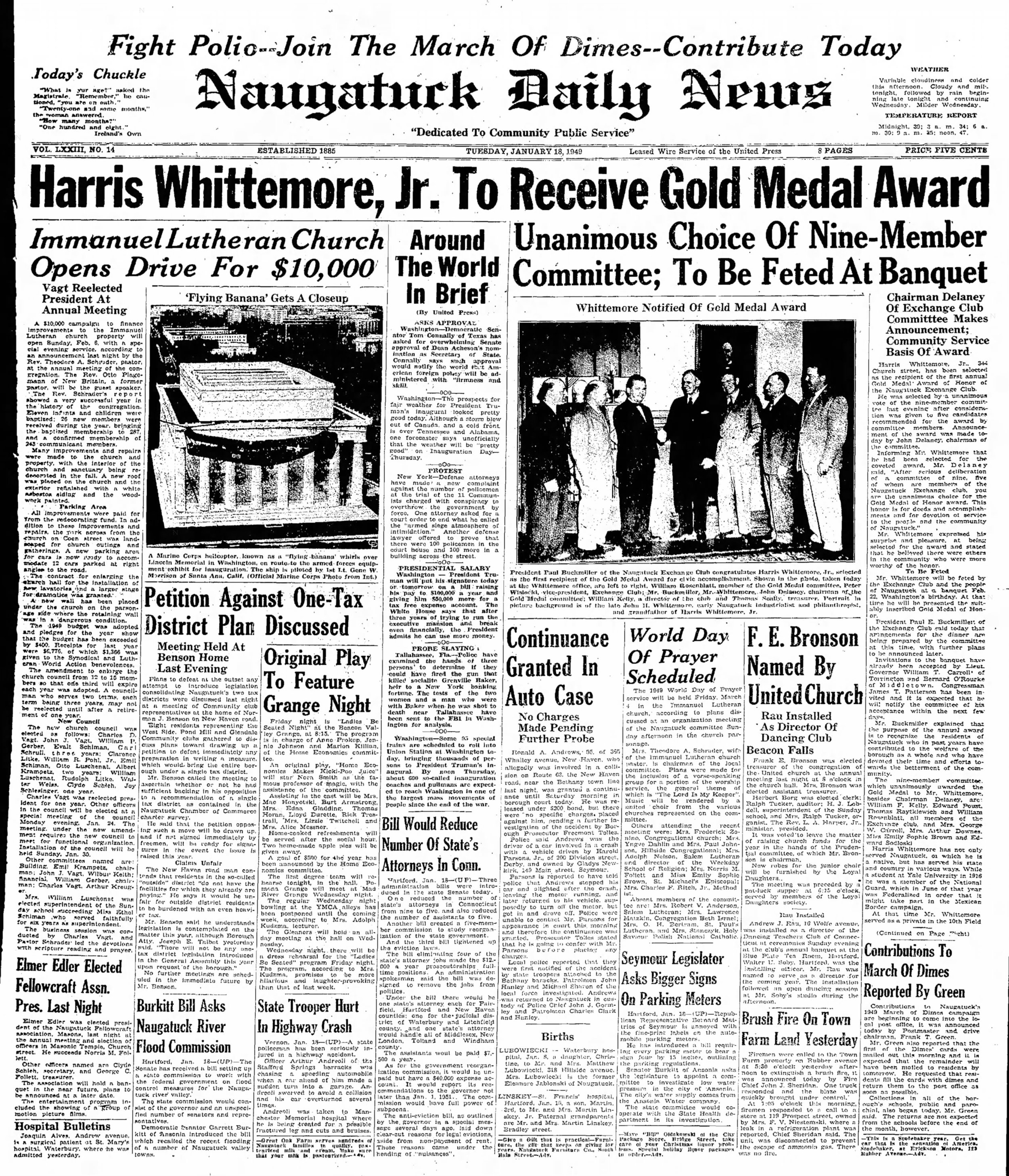
Naugatuck Daily News - Tue, Jan 18, 1949
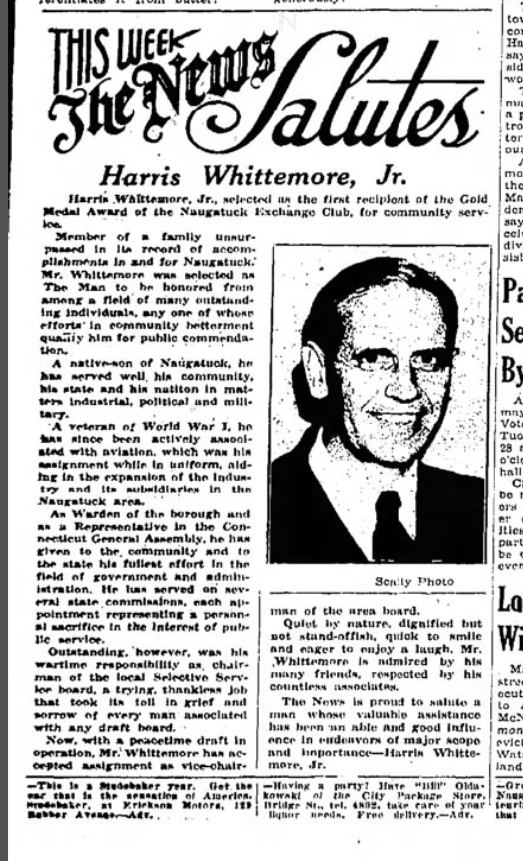
Naugatuck Daily News - Sat, Jan 22, 1949
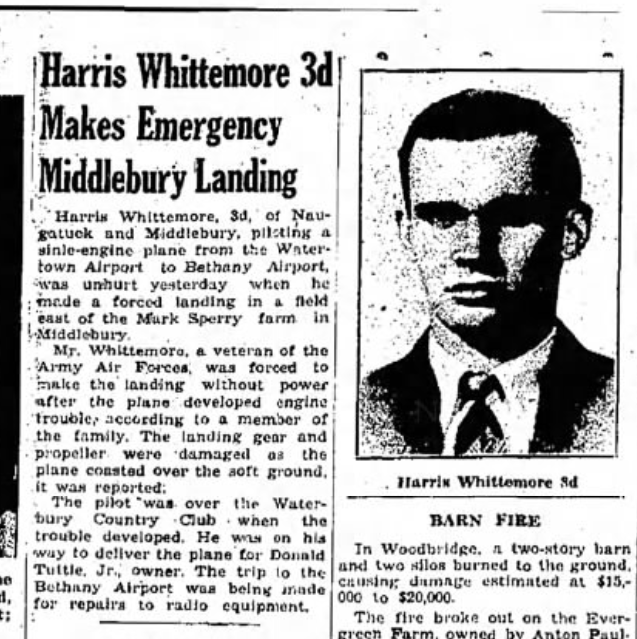
Naugatuck Daily News - Wed, Sep 10, 1947
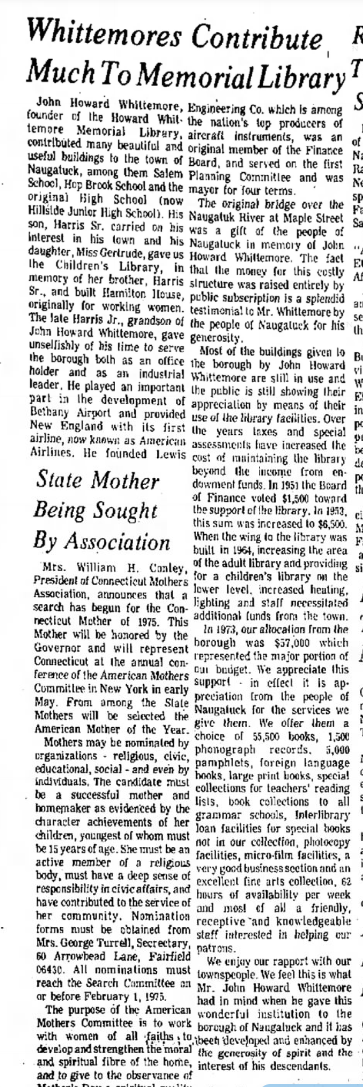
Naugatuck Daily News - Thu, Nov 21, 1974
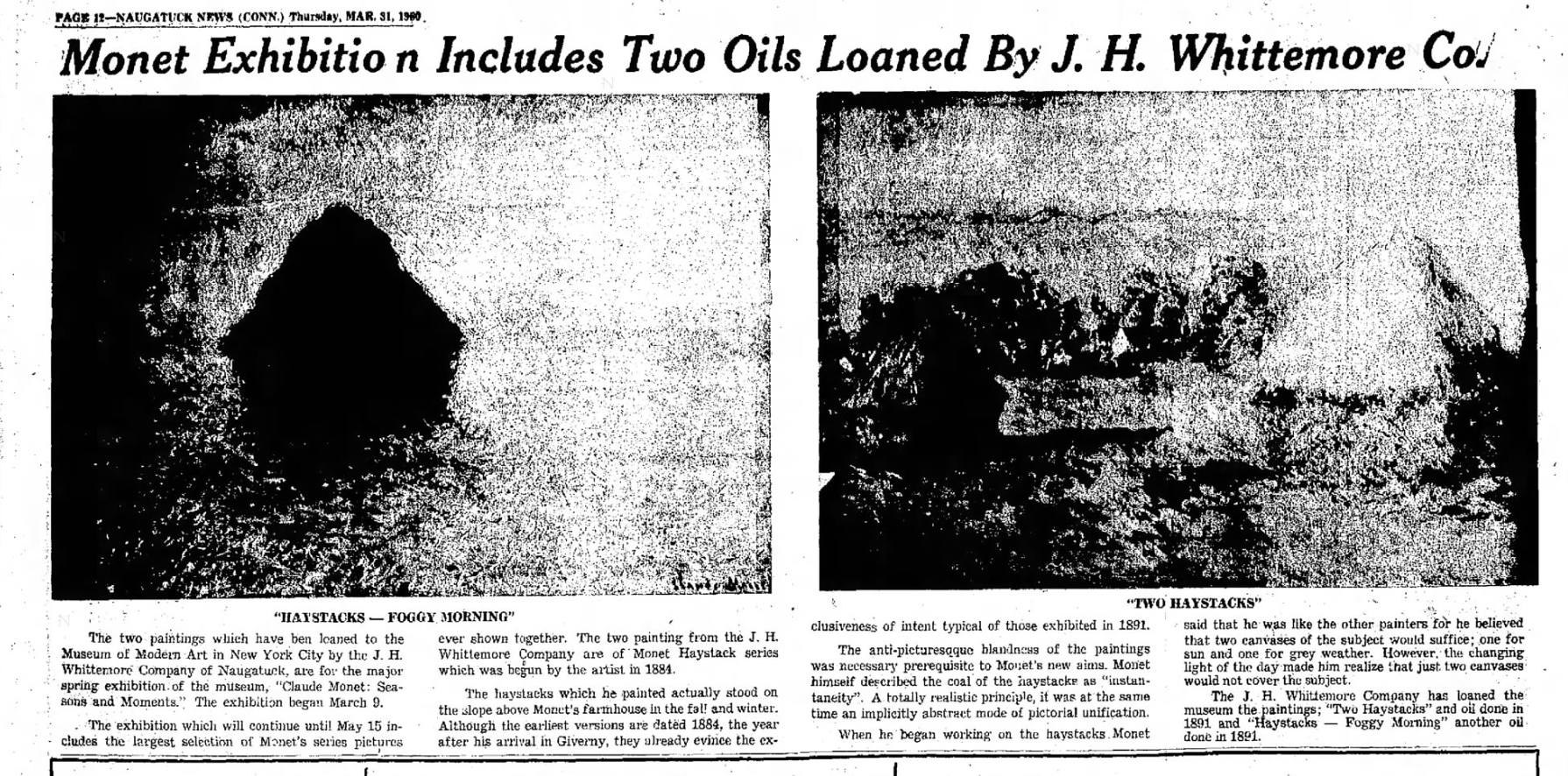
Naugatuck Daily News - Thu, Mar 31, 1960
Online Resource Library