People of Naugatuck
Eliza Ward Barnum
Some Distinguished Naugatuck Women
by D. J. Blackwell
Today, and for some years now, “women’s rights” have been getting considerable attention. Because they have won many rights the call for such now is less strident than in the past. Many groups of both sexes have talked much about rights, sometimes forgetting that there are no rights without duties or obligations. This seems to be better understood now than in the past. It used to be said, “A woman’s place is in the home”, but today, many women are effective in the professions, business and other fields. Gradually women have taken a more active role in community and civic affairs. This was true in Naugatuck and it might be worthwhile to consider some of these people and their contributions to life in town.
…
One well known and civic-minded citizen in Naugatuck, Eliza Ward Barnum, wife of Eli Barnum who built the brick blocks on Church Street in 1887 and 1894 still serving this community, was an active person with many interests who many years ago presented a paper at the Women’s Study Club called Joys of Reminiscence in which she described her childhood growing up in Naugatuck where she had lived all her life. It is a remarkable picture of life in the early days of the town and contributes much to understanding how life in this community developed.
Reference -Naugatuck Historical Society News, September/October 1998
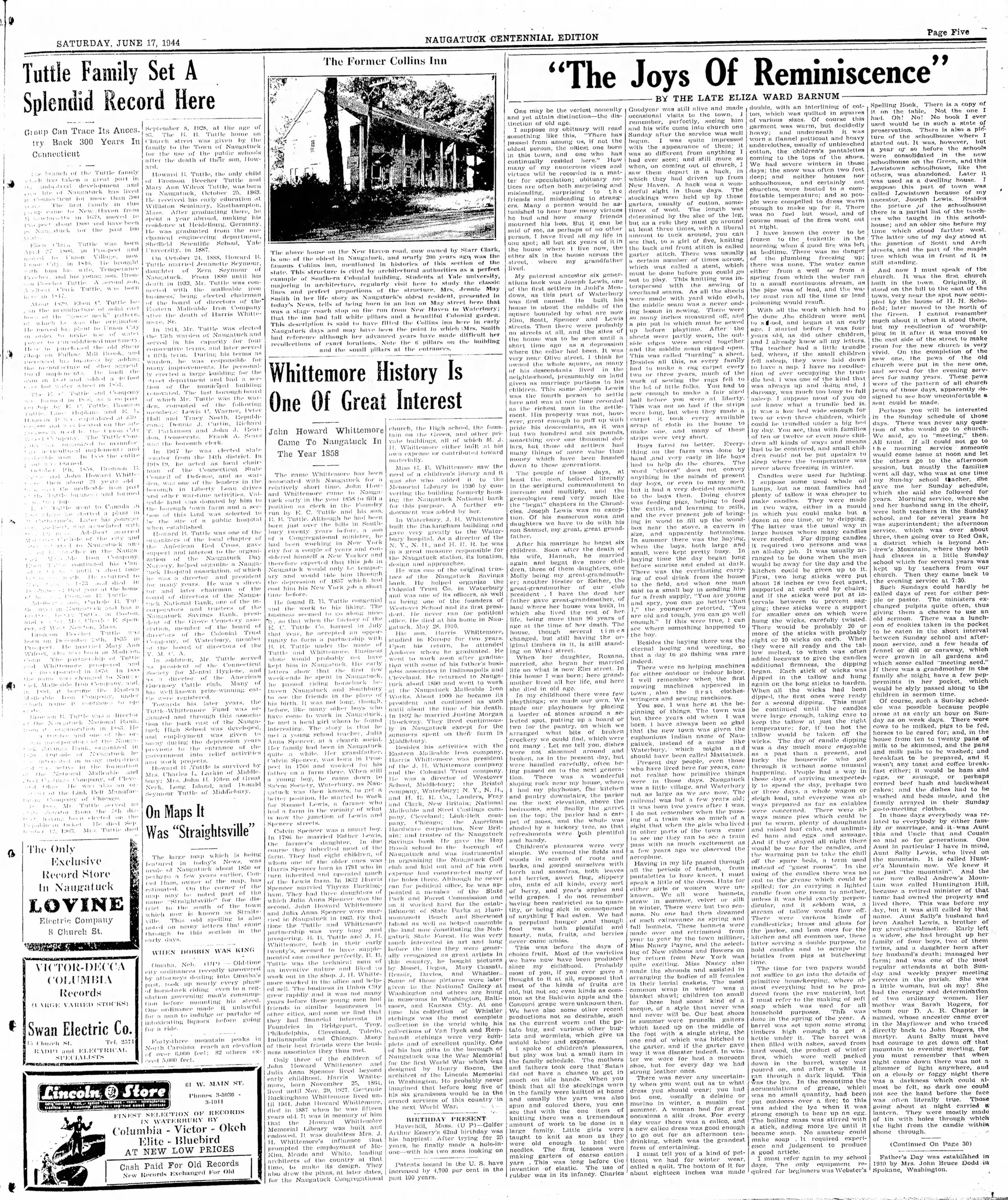
“The Joys of Reminiscence”
By: Eliza Ward Barnum
One may be the veriest nonentity and yet attain distinction—the distinction of old age.
I suppose my obituary will read something like this, “There has passed from among us, if not the oldest person, the oldest one born in this town, and one who has continually resided here.” How many of my numerous vices and virtues will be recorded is a matter for speculation; obituary notices are often both surprising and misleading, surprising to the friends and misleading to strangers. Many a person would be astonished to hear how many virtues he had and how many friends mourned his loss. But it can be said of me as perhaps of no other person, I have lived all my life in one spot; all but six years of it in the house where I live now; the other six in the house across the street, where my grandfather lived.
My paternal ancestor six generations back was Joseph Lewis, one of the first settlers in Judd’s Meadows, as this part of Waterbury was first named. He built his house in about the middle of the square bounded by what are now Elm, Scott, Spencer and Lewis streets. Then there were probably no streets at all, and the sites of the house was to be seen until a short time ago as a depression where the cellar had been. It was very near Olive street. I think he owned the whole square, as many of his descendants lived in the neighborhood, presumably on land given as marriage portions to his children. This same Joseph Lewis was the fourth person to settle here and was at one time recorded as the richest man in the settlement. His property was not, however, great enough to puff up with pride his descendants, as it was but two hundred and six pounds and something over one thousand dollars, but those old settlers had many things of more value than money which have been handed down to these generations.
The people of those days, at least the men, believed literally in the scriptural commandment to increase and multiply, and the genealogies read very much like the “begat” chapters in the Chronicles. Joseph Lewis was no exception. Of his numerous sons and daughters we have to do with his son Samuel, my great, great grandfather.
After his marriage he begat six children. Soon after the death of his wife, Hannah, he married again and begat five more children, three of them daughters, one Molly, being my great-grandmother; another Hester or Esther, the great-grandmother of our club president. I have the deed her father gave my great-grandmother, of land where her house was built, in which she lived the rest of her life, being more than 90 years of age at the time of her death. The house though several times changed, but still having the original timbers in it, is still standing on Ward street.
When her daughter, Roxana, married, she began her married life on what is now Elm street. In this house I was born; here grandmother lived all her life, and here she died in old age.
In my childhood there were few playthings; we made our own. We made our playhouses by placing a border of stones around a selected spot, putting up a board or two for the pantry, on which we arranged what bits of broken crockery we could find, which were not many. Let me tell you, dishes were not slammed around and broken, as in the present day, but were handled carefully, often being passed on to the next generation. There was a wonderful sloping rock near my house, where I had my playhouse, the kitchen and pantry downstairs, the parlor on the next elevation, above the bedrooms, and finally the garret on the top; the parlor had a carpet of moss, and the whole was shaded by a hickory tree, so that refreshments were both plentiful and handy.
Children’s pleasures were very simple. We roamed the fields and woods in search of roots and barks, and gorged ourselves with birch and sassafras, both leaves and berries, sweet flag, slippery elm, nuts of all kinds, every sort of berry, and year’s apples and wild grapes. I do not remember having been restricted as to quantity, or being sick in consequence of anything I had eaten. We had a perpetual hunger, and though food was both plentiful and hearty, nuts, fruits, and berries never came amiss.
This was before the days of choice fruit. Most of the varieties we have now have been produced since my childhood. Probably most of you, if you ever gave a thought to it at all, supposed that most of the kinds of fruits are old, but not so; even kinds as common as the Baldwin apple and the Concord grape were unknown then. We have also some other recent productions not so desirable, such as the currant worm and the potato bug, and various other buglets and wormlets, which give us untold labor and expense.
I spoke of children’s pleasures, but play was but a small item in the family schedule. The mothers and fathers took care that Satan did not have a chance to get in much on idle hands. When you think that all the stockings worn in the family were knitted at home and usually the yarn was also spun and colored there, you can see that with the one item of knitting there was a tremendous amount of work to be done in a large family. Little girls were taught to knit as soon as they were old enough to hold the needles. The first lessons were making garters of coarse cotton yarn. This was long before the invention of elastic. The use of rubber was in its infancy. Charles Goodyear was still alive and made occasional visits to the town. I remember, perfectly, seeing him and his wife come into church one Sunday after the service was well begun. I was quite impressed with the appearance of them; it was so different from anything I had ever seen; and still more so when, on coming out of church, I saw them depart in a hack, in which they had driven up from New Haven. A hack was a wonderful sight in those days. The stockings were held up by these garters, usually of cotton, sometimes of wool. The length was determined by the size of the leg, but as a rule they must go around at least three times, with a liberal amount to tuck around, you can see that, to a girl of five, knitting the back and front stitch is called the garter stitch. There was usually a certain number of times across, which was called a stint, which must be done before you could go out to play. This knitting was interspersed with the sewing of overhand seams. As all the sheets were made with yard wide cloth, the middle seam was a never ending lesson in sewing. There were so many inches measured off, and a pin put in which must be sewed up before playtime. After the sheets were partly worn, the outside edges were sewed together and the middle seam ripped open. This was called “turning” a sheet. Besides all this, as every family had to make a rag carpet every two or three years, much of the work of sewing the rags fell to the lot of little folks. You had to sew enough to make a fair sized ball before you were at liberty. This was not so bad if the strips were long, but when they made a carpet it took every available scrap of cloth in the house to make one, and many of these strips were very short.
Boys fared no better. Everything on the farm was done by hand, and very early in life boys had to help do the chores. The word “chores” does not convey anything in the minds of present day boys, or even to many men, but it had a very decided meaning to the boys then. Doing chores was feeding pigs, helping to feed the cattle, and learning to milk, and the ever present job of bringing in wood to fill up the woodbox near the stove, a cavern in size, and apparently bottomless.
In summer there was the haying, when the boys, both large and small, were kept pretty busy. In haying time the day began long before sunrise and ended at dark. There was the everlasting carrying of cool drink from the house to the field, and when one man said to a small boy in sending him after a fresh supply, “You are young and spry, you can go better than I,” the youngster retorted, “You are old and tough, you can go well enough.” If this were true, I can see where something happened to the boy.
Besides the haying, there was the eternal hoeing and weeding, so that a day to go fishing was rare indeed.
There were no helping machines for either outdoor or indoor labor. I well remember when the first machines appeared in town, also the first clothes-wringers and sewing machines.
You see, I was here at the beginning of things. The town was but three years old when I was born. I have always been so glad that the new town was given the euphonious Indian name of Naugatuck, instead of a name like Waterbury, which might and should have been called Mattatuck.
Present day people, even those who have lived here for years, cannot realize how primitive things were in those days. Naugatuck was a little village, and Waterbury not as large as we are now. The railroad was but a few years old; it was born two years after I was. I do not remember when the passing of a train was so much of a sight that when the girls who lived in other parts of the town came to see me they ran to see a train pass with as much excitement as a few years ago we observed the aeroplane.
Having in my life passed through all the periods of fashion, from pantalettes to bare knees, I must speak a little of the dress. Hats for either girls or women were unknown. We all wore bonnets, straw in summer, velvet or silk in winter. There were but two seasons. No one had then dreamed of such extravagance as spring and fall bonnets. These bonnets were made over and retrimmed from year to year by the town milliner, Miss Nancy Payne, and the selecting of New ribbons and flowers on her return from New York was quite exciting. Miss Nancy also made the shrouds and assisted in arranging the bodies of all females in their burial caskets. The most common wrap in winter was a blanket shawl; children too small for these had some kind of a sacque, of a style that never was and never will be. Our best shoes in summer were prunella gaiters which laced up on the middle of the foot with a single string, the one end of which was hitched to the garter, and if the garter gave way it was disaster indeed. In winter we wore for best a morocco shoe, but for every day we had strong leather ones.
There was never any uncertainty when you went out as to what dress you should wear; you had but one, usually a delaine or merino in winter, a muslin for summer. A woman had for great occasions a silk dress. For every day wear there was a calico, and a new calico dress was good enough to go out for an afternoon tea-drinking, which was the grandest form of entertaining.
I must tell you of a kind of petticoat we had for winter wear, called a quilt. The bottom of it for about eighteen inches was made of double, with an interlining of cotton, which was quilted in squares of various sizes. Of course this garment was warm, but decidedly heavy; and underneath it was worn a flannel petticoat and heavy underclothes, usually of unbleached cotton, the children’s pantalettes coming to the tops of the shoes. We had severe winters in those days; the snow was often two feet deep; and neither houses nor schoolhouses, and certainly not churches, were heated to a comfortable temperature; and so people were compelled to dress warm enough to make up for it. There was no fuel but wood, and of course most of the fires went out at night.
I have known the cover to be frozen to the teakettle in the morning when a good fire was left at bedtime. There was no danger of the plumbing freezing up; there was none. The water came either from a well or from a spring from which the water ran in a small continuous stream, as the pipe was of lead, and the water must run all the time or lead poisoning would result.
With all the work which had to be done, the children were sent to school, and began at an early age. I started before I was four years old, as did other children, and I already knew all my letters. The teacher had a little trundle bed, where, if the small children fell asleep, they were laid down to have a nap. I have no recollection of ever occupying the trundle bed. I was one of the kind that was always up and doing and, I daresay, was much too busy to fall asleep. I suppose most of you do not know what a trundle bed is. It was a low bed wide enough for two or even three children, which could be trundled under a big bed by day. You see, that with families of ten or twelve or even more children all kinds of ways and means had to be contrived, and small children could not be put upstairs to sleep where the temperature was never above freezing in winter.
Candles were used for lighting. I suppose some used whale oil lamps, but as most families had plenty of tallow it was cheaper to make candles. They were made in two ways, either in a mould in which you could make but a dozen at one time, or by dipping. The latter was the usual way in large houses where many candles were needed. For dipping candles it required two persons and was an all-day job. It was usually arranged to be done when the men would be away for the day and the kitchen could be given up to it. First, two long sticks were put about 18 inches or two feet apart, supported at each end by chairs; and if the sticks were put at intervals between to prevent sagging; these sticks were a support for smaller ones on which were hung the wicks, carefully twisted. There would be probably 20 or more of the sticks with probably eight or 10 wicks on each. When they were all ready and the tallow melted, to which was often added beeswax to give the candles additional firmness, the dipping began. Each stick of wicks was dipped in the tallow and hung again on the long sticks to harden. When all the wicks had been dipped, the first ones were ready for a second dipping. This must be continued until the candles were large enough, taking care to keep the tallow at just the right temperature; for, if too hot the tallow would be taken off the wicks. The day of candle dipping was a day much more enjoyable as a past than a present, and lucky the housewife who got through it without some unusual happening. People had a way in those days of arriving unexpectedly to spend the day, perhaps two or three days, a whole wagon or sleigh load, and everyone was always prepared as far as eatables were concerned. There were always mince pies which could be put to warm, plenty of doughnuts and raised loaf cake, and unlimited ham and eggs and sausage. And if they stayed all night there would be use for the candles, and the warming pan to take the chill off the spare beds, a term used instead of “guest rooms”. In the using of the candles there was no end to the grease which could be spilled; for, in carrying a lighted candle from one room to another, unless it was held exactly perpendicular, and it seldom was, a stream of tallow would flow off. There were various kinds of candlesticks; brass and glass for the parlor, and iron ones for the kitchen and all common use, these latter serving a double purpose, to hold candles and to scrape the bristles from pigs at butchering time.
The time for two papers would not suffice to go into the details of primitive housekeeping, where almost everything had to be produced from the raw material, but I must refer to the making of soft soap which was used for all household purposes. This was done in the spring of the year. A barrel was set upon some strong timbers high enough to get a kettle under it. The barrel was then filled with ashes, saved from hard wood, the product of winter fires, which were well packed down in the barrel, water was poured on, and after a while it ran through a dark liquid. This was the lye. In the meantime the accumulations of grease, which was no small quantity, had been put outdoors over a fire; to this was added the lye when it was strong enough to bear up an egg. The boiling mass was stirred with a stick, adding more lye until it became soap. No amateur could make soap. It required experience and judgement to produce a good article.
I must refer again to my school days. The only equipment required for beginners was Webster’s Spelling Book. There is a copy of it on the table. Not the one I had. Oh! No! No book I ever used would be in such a state of preservation. There is also a picture of the schoolhouse where I started out. It was, however, but a year or so before the schools were consolidated in the new schoolhouse on the Green, and this Lewistown schoolhouse, like the others, was abandoned. Later it was used as a dwelling house. I suppose this part of town was called Lewistown because of my ancestor, Joseph Lewis. Besides the picture of the schoolhouse there is a partial list of the teachers who taught in this schoolhouse; and an older one before my time which stood farther west. The latter one of my day stood at the junction of Scott and Arch streets, and the part of the maple tree which was in front of it is still standing.
And now I must speak of the church. It was the first church built in the town. Originally, it stood on the hill to the east of the town, very near the spot now occupied by the house of H. H. Schofield; later moved to the north of the Green. I cannot remember much about it when it stood there, but my recollection of worshipping in it after it was moved to the east side of the street to make room for the new church is very vivid. On the completion of the new one, the pews of the old church were put in the new one, and served for the evening services for many years. These pews were of the pattern of all church pews of those days, apparently designed to see how uncomfortable a seat could be made.
Perhaps you will be interested in the Sunday schedule of those days. There was never any question of who would go to church. We said, go to “meeting,” then. All must. If all could not go to the morning service someone would come home at noon and let the others go to the afternoon session, but mostly the families went all day, who was at one time my Sunday school teacher, she gave me her Sunday schedule, which she said she followed for years. Morning service, where she and her husband sang in the choir, were both teachers in the Sunday school, and for several years he was superintendent; the afternoon service, which was over about three, then going over to Red Oak, a district which is beyond Andrew’s Mountain, where they both had classes in a little Sunday school which for several years kept up by teachers from church. Then they came back the evening service at 7:30.
Such Sundays could hardly be called days of rest for either people or pastor. The ministers changed pulpits quite often, giving them a chance to use old sermon. There was a luncheon of cookies taken in the pocket to be eaten in the short interval between Sunday school and afternoon service, and a few heads of fennel or dill or caraway, which were grown in all gardens and which some called “meeting seed.” If there was a grandmother in the family she might have a few peppermints in her pocket, which would be slyly passed along to the children in sermon time.
Of course, such a Sunday schedule was possible because people arose at as early an hour on Sunday as on week days. There were cows to be milked, pigs to be fed, horses to be cared for; and, in the house from ten to twenty pans of milk to be skimmed, and the pans and milk pails to be washed; and breakfast to be prepared, and it wasn’t any toast and coffee breakfast either; it would be ham and eggs, or sausage, or perhaps corned beef hash and buckwheat cakes; and the dishes had to be washed and beds made, and the family arrayed in their Sunday go-to-meeting clothes.
In those days everybody was related to everybody by either family or marriage, and it was Aunt this and Uncle that and Cousin so and so for generations. One Aunt in particular I have in mind, Aunt Sally Lewis, who lived on the mountain. It is called Hunter’s Mountain now. We knew it as just “the mountain.” And the one now called Andrew’s Mountain was called Huntington Hill, because a retired minister of that name had owned the property and lived there. This was before my day, but it was still called by that name. Aunt Sally’s husband had been Asahel Lewis, a brother of my great-grandmother. Early left a widow, she had brought up her family of four boys, two of them twins, and a daughter born after her husband’s death; managed her farm; and was one of the most regular attendants at both Sunday and weekly prayer meeting services in the parish. She was a little woman, but oh my! She had the energy and determination of two ordinary women. Her mother was Sarah Rogers, for whom our D. A. R. Chapter is named, whose ancestor came over in the Mayflower and who traced directly back to John Rogers, the martyr. Aunt Sally must have had courage to get down off that mountain to evening meeting, for you must remember that when night came down there was not a glimmer of light anywhere, and on a cloudy or foggy night there was a darkness which could almost be felt, so dark one could not see the hand before the face was often literally true. Those going about at night carried a lantern. They were mostly made of tin with holes through which the light from the candle within shone through.
As I said before, rubber was in its infancy. Overshoes as we know them now were unknown. The few there were, were very thick and heavy and much too expensive for ordinary wear, and rubber boots were unknown. Men wore boots almost entirely; fine calfskin for best, but heavy cowhide boots for ordinary wear. As men had to work out of doors in all kinds of weather, the boots must be as nearly as possible waterproof. To accomplish this, they were greased with tallow quite often. A dish was kept for this purpose, which could be put upon the stove to heat as it must be quite warm to strike in. You can imagine what it would mean to a neat housekeeper to have half a dozen pairs of boots greased in the kitchen and left beside the stove to dry. Of course, if any got on the soles it would be tracked on the carpet. No wonder the women had a best room which was kept for company. It was the only way to have a decent place. To facilitate the removal of these boots from the feet there was a boot-jack. I have one yet, made of a heavy piece of wood with a large notch in one end in which to place the heel; this end had a cross piece to raise it from the floor. It took you in a new place. Sitting in these pews was but one remove from sitting in the stocks. How different those in the new church, the last word in ease and comfort in these days. I continued to worship in this church until it was removed to make room for the present one. So you see, I have outlived two church buildings. I hardly think I shall outlive the third. It must have been made on the plan of “The One Hoss Shay.” The second church, after being abandoned for church services, was used for various purposes. What remains of it after two fires is now occupied by a Chinese laundry. Shades of our fathers! the heathen have come to our very doors.
There were in those early days a few pianos, as nearly as I can recollect not more than 12, probably less, also a few melodeons. There was, I think, but one music teacher, a Mrs. Merrill, who lived on Cherry street. I do not think she was very much of a teacher, for very soon the family removed to Waterbury and went into the doughnut business. Mrs. Merrill must have been the most important member of the firm, as her husband, though a man of education, was too lazy to work, though he did drive the doughnut wagon. Later on Melodeons became quite common, and one of the better ones was the only musical instrument in our church long after I was married.
A few, very few families had a Brussels carpet in the parlor. The patterns of these carpets were so large that in an ordinary sized room there would not be space for more than two whole figures.
A reference to the burial customs of long ago may interest you. Of course, there were no means of knowing the happenings of the town but the passing of news from house to house, and so when a person died the fact was announced by the tolling of the bell of the church they attended. When the bell began to toll everybody stopped their work to listen and learn if possible who had passed away. The bell tolled for a few minutes, then stopped, then gave one stroke to denote the death of a male; two, if a female; stopped again, then tolled the age by tens. There was no getting away from one’s age in those days, for no one would have the nerve to lie about the age which was to be solemnly sounded by the church bell. I suppose these customs seem absurd to the present generation, but in those days when everyone knew everyone else it was a solemn sound, and many tears fell as the bell told us that a dear friend was gone. On the day of the funeral the bell tolled again to give notice of it, and as the procession passed to the burial place it tolled the passing bell. When this custom was abandoned the older people felt that the funeral lacked something of solemnity and proper respect. There was nothing to mitigate the horror of burial then, no flowers, perhaps in summer, a few, from the gardens of friends; and at the grave the coffin was placed in the box, the cover screwed down, and lowered by leather straps in the hands of the pallbearers. A funeral, sad enough at best, was a horror then.
To supplement the minister’s salary, he was given a donation. This was a two days’ festival. Now, a donation might be mostly party and little giving, and many stories and jokes have been told of donation parties. But with us it was a real generous giving. Money was scarce and supplies plentiful, and, I tell you, those were famous more to the minister that way. And so, on donation day there were loads of wood, bushels of potatoes and other vegetables, hams, spareribs, butter, cheese, eggs, and other supplies carried to the parsonage. The older people went in the afternoon and stayed to supper which they had provided; and, I tell you, those were famous cooks in those days. There were rye bread and butter, doughnuts and loaf cake, cheese, dried beef, and honey, and very likely two or three kinds of preserves, and pies of all kinds, very likely cold meats, with a possible chicken pie or two. No one ever heard of dyspepsia then. I believe there was one man who claimed to have it, but he was something of a curiosity, like a circus freak. The young people went in the evening. There were young people in the minister’s family. And I daresay they might have played such exciting games as authors, or possibly Spat in and Spat out; certainly nothing more worldly unless it might have been Blind Man’s Buff or Run Around the Chimney; for they were very strict about amusements in those days; and at an early hour they departed, the young men seeing the girls home. On the afternoon of the following day the children came, and after playing a few simple games we were served with refreshments. I can think now how good the doughnuts and other cakes tasted. Those who had not made any other gift at this time gave a little money and so felt that they had done something. Our minister had been a missionary; I think in Turkey or some of those eastern countries and had many things of interest on which he was very dignified and awe we gazed with much awe. In fact, to have taken a Jumping Jack to inspiring person I should as soon church as to have said anything funny to him. He seemed to me like the old prophets we studied about in Sunday school.
What a task it was in those days to get ready for the coming winter. First, there was the digging of potatoes, gathering of apples, husking of corn; and last, but not least, the getting of the supply of wood for the fires. The cutting and piling of the trees in the woods, which, as soon as snow fell—and in those days snow came early, usually by Thanksgiving the ground was well covered, was hauled on sleds to the house. All this wood had to be worked up by hand. For wood for summer use there would be birch and alder, but for the winter it would be oak and hickory and chestnut, that would make a hot and lasting fire. The smaller wood would be cut by hand. For wood for summer use provided with an axe, and until the woodpile was well under way there was little rest for man or boy. As soon as it was settled cold weather butchering began. This was certainly a busy time, both indoors and out. There was the trying out of lard and tallow, making of sausage and head-cheese—we called it souse then—packing down the pork and beef to salt, curing and smoking of hams and drier beef, a general preparation for the long winter. The rye must be taken to mill to be made into flour, as most of the bread was made of rye; and last but not least, the buckwheat must be carried to mill that there might be no lack of the buckwheat cakes, which was one of the regular articles for breakfast. Whatever else was lacking, the pancake batter was always put to raise at night. To cook pancakes for a family of eight or ten people on a winter’s morning was a fair-sized job, and this breakfast would be served by candle light, as there was no lying in bed in those days. That is one reason so much work was accomplished in those days. People were up and at it.
Perhaps in no one thing are we made comfortable in those days than in the protection from fire, or rather in the facilities for putting out a fire. Now, when the fire whistle sounds, we do not think much about it unless the call is in our neighborhood. In those days when the church or factory bell, there were no whistles, gave notice of a fire, every man was expected to respond with a pail, and as soon as possible two lines of men were formed from the fire to the nearest water supply, one to pass the filled, the other the empty pails. Of course, if the fire had gained much headway, the building was doomed and the efforts were directed towards saving adjoining ones or removing furniture from the threatened buildings. This was tragedy. The stories of taking beds and pillows carefully downstairs and throwing looking-glasses and other breakables out of windows was often true. What was salvaged from a fire was often by no means saved. Naugatuck has in the past suffered severely from fires. After the manufacturing of rubber goods began we had many large fires. The factory on Rubber Avenue has been burned twice. Both factories on Maple street were burned in one night. I think it was the night before Christmas. The woolen mill has burned twice, the first time on a very hot Sunday, it was said, from spontaneous combustion; the second time on a very cold night in winter. In this fire the watchman was so very badly burned that he lived but a few days after. It is not so many years ago that the Rubber Regenerating plant was burned, the fire lasting for weeks in the piles of old rubber shoes. Besides these larger fires were numerous smaller ones. Added to this, there was the collapse of the wooden carriage business, which occupied the wooden factory buildings on Church Street. This bade fair to be a very important industry; but as most of the carriages were sold in the South, the outbreak of the Civil War brought this to an end with such financial loss that the whole thing went to pieces and was never resumed. Such heavy losses retarded the growth of the town, but the indomitable spirit which inspired the early settlers to fight bears and wildcats and battle with nature for a living and home in the wilderness was still alive in their descendants, and the new buildings arose from the ashes of the old, and as one generation passed the next took up the battle and it is still going on; not the same kind of a battle their ancestors waged, but success of any kind is only won after strife.
I have been thinking how completely the people lived from the farms. So far as I can think, they bought sugar, molasses, tea, coffee, (which was used but little, tea being the common drink which we drank early and often and of great strength), a few spices, soda, and some cream of tartar, codfish, some white flour, and occasionally a few lemons and raisins; little else. There were no meat markets, the nearest thing to a market being a meat cart, which came to the doors once or twice a week. Fish could then be found in the rivers and lakes, even in the Naugatuck river, and fishing for shad was then quite an industry in Derby. In shad time peddlers brought around the fish, and occasionally a clam peddler appeared, but mostly the people took two or three days off and went clamming.
The West Haven shore was all open shore, a few farmers living near the beach. These farmers had large houses, with a long room with a stove and numerous rough chambers, probably for the special use of the clammers. Each family carried provisions but depended largely upon the clams to furnish food. I can remember how excited I used to be when it was decided to go clamming, and when we arrived in sight of the water nothing could exceed my delight. There were plenty of long clams to be dug from the sand; this was a job for the women and children. The real clamming business, taking the round clams from the water, was a man's job, though some women became quite expert at it. Some felt out the clams with their feet, but the men used a rake with long, curving teeth, and if the clams were plentiful, could get two or three at a time. When caught by either method, they were put into a bag, which must be carried along. When one had secured a half bushel, and sometimes a bushel would be taken during one tide, it was some job to get to land, especially if the person stayed out too long and the tide well turned. Never, while I live, shall I forget how good those clams tasted. Everyone ate as long as they could swallow, and were ready for another meal long before it was time for it. There were no bathing suits for these expeditions. The women wore old dresses, the men old shirts and trousers. When I tell you that one could buy all the lobsters one wished for not more than seven cents a pound, you will realize that times have changed. That was the price of the first we ever had, which came from the market in Waterbury I daresay the price at the shore was much less.
Times have changed indeed. We have made many wonderful advances in material prosperity, and invented and acquired many things for our comfort and happiness. But we have lost some things which can never be replaced. Instead of our river being a stream of pure water, a pleasure to look at and in which it was safe to bathe, we have now an open sewer. The air is now full of smoke and other products of the factories, and many of my favorite haunts are now laid waste. Trees and other landmarks are gone and the old-time stillness is replaced by a continual roar and din, and in place of the old neighbors and friends there is a horde of barbarians, akin to the Goths and Vandals, whose distinction between mine and thine is very indistinct.
Along in the seventies we had some advantages in some respects greater than we have now. Waterbury had built a new city hall with a large auditorium, though I confess I had never heard the word then, and brought under the management of Jean Jacques many first class entertainments. There I heard Edwin Booth in Hamlet, Mary Anderson in Ingomar, Lawrence Barrett in Richelieu, also in the company with E. L. Davenport, and two other stars in Julius Caesar, Davenport in Othello, Joseph Jefferson in Rip Van Winkle, and the Rivals; and Henry Ward Beecher, J. B. Gough, Wendell Phillips, and others lectured there. I do not think the best seats were above two dollars. We usually paid one dollar. Think of seeing Edwin Booth for one dollar.
And now I have come along on the road of life and, as when one takes a long journey to the top of a a mountain, and looks back over the road they have come, so having reached the top of the mountain of life, I can look back over the road I have traveled. Here I see a place where it was rough and the stones bruised my feet; there is a place that was cool and shady with ferns and flowers; in another place I stopped to rest under a grand old tree and drink from a cool spring. As I look along the road, I see some old houses where I rested and had sweet companionship, and some of the people of those houses walked with me for a while. There was a large company of us when we started, but one by one they have dropped out and lain down to rest. I see one place where I took a baby in my arms, and by and by, when this one could walk alone, there was another. They both walk with me still and there are little ones in the company now who call me grandma. The way beyond is shrouded in mists and the road is hidden. I have to come to
“The last of life, for which life is made,”
and can only complete Browning’s thought:
“My times are in thine hand
Let age approve of youth and
death complete the whole.”
-
![]()
Naugatuck Daily News - Sat, Jun 17, 1944