
Civil War
Naugatuck’s 236 Civil War Soldiers, 1861 to 1865
Robert Armstrong
John Adamson
Walter Anderson
George Anderson
Valentine Arenholtz
William J. Abernethy
Charles L. Alling
William Adams
Abiram Atwood
Frank Butler
William J. Beardsley
James E. Bennett
John Bulliher
Patrick Burke
George Butler
Luzerne Baldwin
Michael Burns
Charles A. Beardsley
Henry C. Baldwin
William Bodman
Franklin K. Beecher
Robert Baldwin
William Beardsley
John Burke
Luther M. Baldwin
Philip Boylan
William F. Bissell
Henry Baker
Matthew Boylan
Charles Bendalow
John Bacon
Minor S. Baldwin
Isaac H. Beecher
William Campion
Frank Carter
Michael Clow
Henry A. Cook
Joseph A. Chamberlin
Daniel B. Camp
Oliver G. Camp
Gilbert S. Clark
John Casey, 1st
Julius B. Cook
Robert Candee
Thomas Clancy
John Carry
James Dailey
Daniel Davis
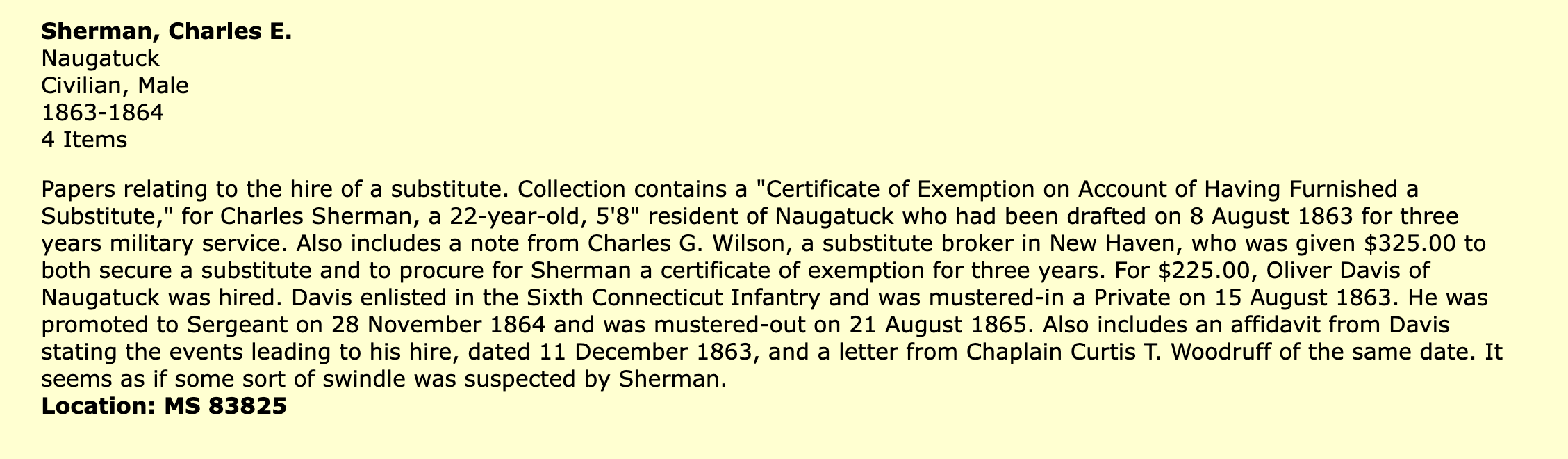
Oliver Davis
William H. Dougal
Patrick Doling
Leonard L. Dougal
Peter H. Donly
Frederick L. Dougal
Nelson H. Davis
Marcus L. Delevan
Joseph Dogan
George H. Deming
James Delaney
John W. Eisenberg
John M. Ellis
Oliver Evans
Charles S. French
Francis Flanagan
Thomas French
Patrick Farrell
John H. Francis
Michael Fruin
Alfred H. French
Thomas Ford
Charles Farrell
Mason Gray
Owen Gannon
Michael Green
James Griffing
Hugh Gannon
Lucius Goodall
William Griffin
Simon Gaven
Frank C. Gerard
Lewis H. Gorham
Bolzor Grosh
Robert L. Hopkins
Joseph I. Hotchkiss, Jr.
James Harrison
Richard E. Hayden
Charles Hoadley
John S. Hayes
John W. Hogan
Joseph Horsley
Oliver Hitchcock
James Hewison
Edward W. Horton
Edwin J. Hickox
Frank B. Hitchcock
Abner F. Hoyt
James D. Hotchkiss
Alonzo Hotchkiss
Patrick Harrigan
Joseph Hunce
Henry T. Hoadley
Michael Horn
George E. Howgate
William S. Hooper
George Hoskins
A. Dwight Hopkins
George H. Hoadley
Charles Hoadley
George L. Hotchkiss
Amos H. Hotchkiss
Bernard Howrigan
William H. Hine
Henry B. Hopkins
Castle E. Isbell
Robert L. Isbell
Henry Jones
William Jackson
Jacob King
Robert Kennedy
Lewis D. King
Henry F. Keyes
Francis H. Keeney
Hugh Kelley
William J. Kane
Joseph O. Kane
Frederick C. Lord
George L. Lewis
Walter B. Lake
John W. Lawton
Franklin S. Lewis
Theodore S. Ladd
Henry C. Lord
Rufus W. Lewis
Charles F. Leonard
Elias F. Merrill
William S. Mann
Timothy Murnann
Frank D. Meers
Thomas Mulvey
James Malone
John Mignaulth
John McLellan
James McKennea
Frank Martin
Harry L. Maginnis
Michael Moran
Daniel McGinnis
Charles L. Neigh
John L. Nichols
Frederick O. Nichols
Franklin S. Nichols
Henry Nichols
Charles L. Norton
Isaac Nichols, 2d
Edward J. Nichols
John O’Donnell
Robert W. Osborn
Daniel Ogle
Jacob Paulus
Sereno Porter
Henry D. Patterson
Charles Pollitt
Charles W. Phelps
George E. Payne
Irwin Peck
Manuel Perry
Richard Platt
Doctor G. Potter
Charles H. Pickett
Elliott R. Pickett
Lawrence Phalan
Henry Phelps
Hiram Patterson
Jonathan H. Pierce
Charles Patterson
Willis E. Payne
Sheldon F. Payne
Nathan Payne
John Platt
James Quinlan
Cornelius J. Rollason
Sylvester P. Richards
Charles S. Riggs
Charles Radebold
James Riley
Patrick Ruth
Edward F. Smith
Andrew M. Sherman
William Strong
Hiram P. Spencer
John Shelley
Dennis Sweeney
Ashbell Stevens
Edward A. Stevens
Henry E. Sears
John Smith
Thomas Stafford
James Somers
Thomas Smith
George Smith
David R. Stevens
William S. Skeels
Lucian H. Spencer
John Sandley
Nelson S. Smith
Merritt C. Saunders
Thomas Saunders
Zerah S. Seymour
William E. Stevens
John Slaybracker
Benjamin W. Seymour
Dwight L. Smith
Alonzo P. Smith
John D. Smith
Charles Tobey
Edward Troy
John M. Thompson
Henry Treadway
Stiles S. Twitchell
George L. Tyler
George S. Tung
Edwin Terrell
Niles Tuttle
George F. Umberfield
Joseph Vanness
William H. Williams
Rev. Curtiss T. Woodruff
Horace N. Williams
Thomas White
Elijah S. Williams
John Williams
Collins E. Wilcox
Mordaunt L. Wilmot
Noyes S. Wilmot
Joel F. Webster
Peter Young
List of Naugatuck Men Enlisted in other Places
Names of the soldiers credited to Naugatuck, already given, the names of those who, while by birth or training Naugatuck men, enlisted elsewhere and appear in the quotas of other towns and other states. The list is imperfect. Those marked with a * are known to have died in the service:
James Adamson
Guy Beecher
*Hubert Beers — Ohio Cavalry Regiment.
Albert E. Budroe — Regular Army.
Charles A. Budroe — U. S. Navy.
Matthew Boylan — Missouri Regiment.
William N. Carroll — Fourteenth Conn. Regiment.
Michael P. Coen — Ninth Conn. Regiment.
Michael Cronan — Ninth Conn. Regiment.
James Conran
Duncan D. Gibbard — Fourteenth Conn. Regiment.
B. C. Hall — Twenty-Seventh Conn. Regiment.
Burr Hine
*Andrew B. Hitchcock — Fifteenth Conn. Regiment.
Charles Hopkins
Major Enos Hopkins — Michigan Regiment.
*Orson Howard — New York Regiment.
Frank Hunt — Connecticut Regiment.
*Lieut. John D. Isbell — Eighteenth Mass. Regiment.
Henry D. Lewis — Fifteenth Conn. Regiment.
Evelyn Porter
Dwight Russell — Fourteenth Conn. Regiment.
Phineas Warner
Coen Street was name for Michael P. Coen, one of the best known Civil War Veterans in Connecticut. This street is on the east side of town. It is a dead end street which can be entered from Oak Street. At the end of the street sits Immanuel Lutheran Church.
Michael Coen was born in Ireland on July 12, 1843, the son of Michael and Catherine (McCaffrey) Coen. The family including Michael Sr., Catherine, elder brother John, and Michael migrated to the U.S. in 1849. They settled in Waterbury where Michael was educated.
When Fort Sumter in North Carolina was fired upon, the Rev. Thomas F. Hendricken, Pastor of the Immaculate Conception Church in Waterbury, called a meeting of the young men of the parish. A company was formed requiring an enlistment for three months. It was later mustered as Company F into the Ninth Regiment Connecticut Volunteers, known as “The Irish Regiment”. Michael, who was 18 years old, was the youngest member of the Company. He was discharged in October 1864, but re-enlisted. He became a member of the U.S. Signal and Telegraph Company until the war ended.
His war engagements were many, most of which were served in Louisiana. He was hospitalized in Baton Rouge in 1862. Read below Michael Coen’s own words telling of his experience in the Civil War written in 1895.
“I was detailed with one member to procure some horses and fell into a trap through false information, but, owing to the speed of my horse escaped under a running crossfire. The important events were the capture of the 3rd Mississippi Regiment Colours, capture of New Orleans and the death of my father and brother in the U.S. Service.”
This quote and accounts written by 62 other Naugatuck veterans of the Civil War can be seen at the Naugatuck Historical Society Museum. It is written in a bound volume called The Memorial Record of Isabell Post #43. Grand Army of the Republic.
After four years of service, Michael returned to Waterbury and later moved to Naugatuck. Here, in 1866, he married Catherine Mulvey. He became an active member of St. Francis Church. He also purchased the property on which the church was built and the land for St. Francis Cemetery on High Street.
As a citizen and business man he was connected with many of Naugatuck’s public enterprises. He was owner and manager of the Salem Spring Ice Co.
In 1894, he was appointed a delegate to the National Convention of the GAR at Pittsburg, PA. He was one of four delegates who returned to the third Mississippi the colours which had been captured by the Ninth Connecticut in New Orleans in 1862. He was selected by the Regimental officers to pose for the model of the statue erected by the Ninth Regiment. It was placed at Bay View Park, City Point, New Haven, Connecticut.
Michael P. Coen died in Naugatuck on April 15, 1910, in his 67th year. He is buried in St. Francis Cemetery.
Source -Naugatuck Historical Society Newsletter, November–December 2005 issue
Lieutenant John D. Isbell.
Lieut. John D. Isbell, after whom Isbell Post, G. A. R., is named, was born in Naugatuck, April 9, 1840, the son of the late John L. and Eliza J. Isbell. He remained at home, a scholar in the public school until the age of eighteen. He was a boy of active mind and most attractive personal qualities, well fitted to make a good soldier.
He went to Springfield, Mass., April 1, 1858, and took a position in the mercantile house of H. N. Carter, in which he remained until the opening of the war. The respect which he won was shown in his appointment as Sunday School Superintendent in Christ Church parish. He received a Lieutenant’s Commission in Co. H of the Eighteenth Massachusetts Regiment, and went out in the first summer of the war. He had not quite filled out his first year of service, when towards the end of the Peninsular campaign, he fell a victim to the typhoid fever. He was about coming home for a short furlough to recruit his shattered health. But the disease had too strong a hold upon him. He had performed faithfully his duties in the campaign and in the battles with which it culminated, and he was exhausted. It was hardly known that he was ill, when he was hopelessly sick. All was done by tender, loving hands that camp life permitted, but in vain. He died July 16, 1862, at Harrison’s Landing, Va.
Col. James Barnes, in writing to Lieut. Isbell’s father, after giving the particulars of his death, said: “It grieves me to communicate this sad intelligence to you, because prizing him as much as I did, I know what an affliction it must be to you. It is a great consolation, however, to all who mourn his loss, to feel as we all do, that he was undoubtedly well prepared for the great change.”
Lieut. Isbell’s body was brought home, and on July 24, 1862, he was buried with military honors from St. Michael’s Church. The funeral sermon was preached by the late Rev. Edwin E. Johnson, then in charge of the church by reason of the absence of the Rector, Rev. C. T. Woodruff, Chaplain of the Sixth Connecticut Regiment. The preacher spoke with deep feeling for he could say of the dead: “We grew up almost side by side, attended the same school, were baptized and confirmed at the same altar.”
In the course of the sermon, Mr. Johnson said of Lieut. Isbell: “It is a pleasant testimony which I am able to give, that in all the varied pursuits with which he has been engaged since he left your midst, he has furnished those who knew him best an example of work, modestly, quietly, and yet faithfully done.” . . . . “The letters of him whose death we mourn, breathing as they did of sincere piety, as well as the testimony of his superior officers acquaint us with the comforting fact, that in all his labors, dangers and privations, ‘he endured as seeing Him who is invisible.’”
“Some few facts have been sent home by those who were with him during the last weeks of his life. They tell us that he suffered much from wearisome marches, yet bore every burden placed upon, nobly, without a murmur. Though we cannot know how acutely the pains of disease preyed upon his youthful constitution, it is pleasant to be assured that he met his end calmly as a true Christian and soldier.” . . . . “We know that he died trusting in the Saviour to whom he gave himself here while yet the dew was fresh around his early path of life. There has been given us an example of one who ever sought to act rightly, who feared not to follow where duty pointed, striving only to accomplish in faith the work given him to do. It has been given us also to trust that he has exchanged a scene of tumult and toil, of bloodshed and passion for the rest that broods over the sleep of the faithful.”
All that was mortal of him whose honored name is borne by Isbell Post, G. A. R., rests in Hillside Cemetery, upon the knoll near the northwest side which overlooks the road along which and the river beside which, he as a boy went day by day to school.
This inscription is upon his monument:
Lieut. John D. Isbell. Co. H, Eighteenth Mass. Regt.
Died at Harrison’s Landing, Virginia, July 16, 1862.
Buried at Naugatuck, July 24.
An only son in the garb of a soldier lies buried here. His superior officers bear testimony that he was much beloved,—a faithful soldier to his country and to the Cross of his Redeemer.
Source - Soldiers’ Monument Dedication Booklet
-
![]()
Naugatuck Daily News - Thu, Nov 17, 1949
During the Civil War, Bronson and John Howard Whittemore produced iron caisson hubs for cannons, as well as agricultural tools like scythes and sickles for the Midwest. After the war, they expanded their production to include steel-laid shears and iron plates for railroad bolts, leading to the establishment of the Pratt Manufacturing Company on Broadway in New York. As the railroad construction boom waned in the late 19th century, they shifted focus to producing galvanized metal fixtures for glass insulators on telephone poles, and by the early 20th century, they manufactured iron components for automobiles. In 1889, they rebranded their company from Tuttle and Whittemore to the Naugatuck Malleable Iron Company, employing over 350 workers at the foundry.
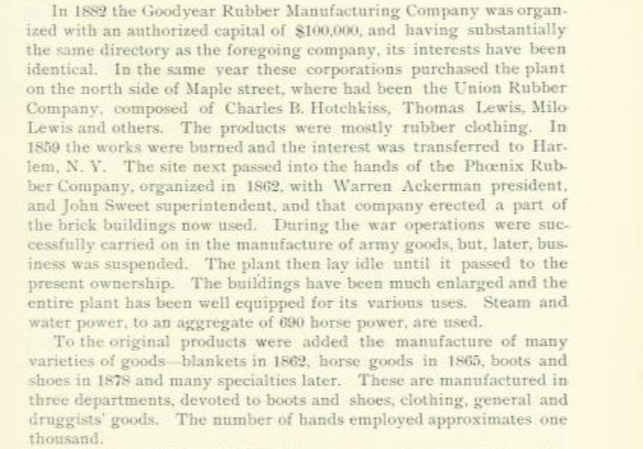
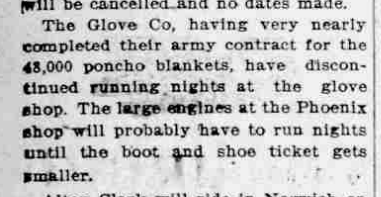
The outbreak of the Civil War created an urgent demand for rubber goods, such as ponchos and boots, for the Union Army. By the 1880s, Naugatuck's rubber factories had expanded significantly, producing thousands of boots and shoes each day. This rapid growth earned the town its reputation as the “first rubber town in America,” cementing Naugatuck's place in industrial history as a leading center for rubber manufacturing.
-
![]()
Source: History of New Haven County, Connecticut (p. 714)
-
![]()
Waterbury Evening Democrat - Sept. 3 1898 - (Naugatuck Column)
-
![]()
CONNECTICUT PHYSICIANS IN THE CIVIL WAR - Page 47
-
![]()
Civil War Manuscripts Project
-
![]()
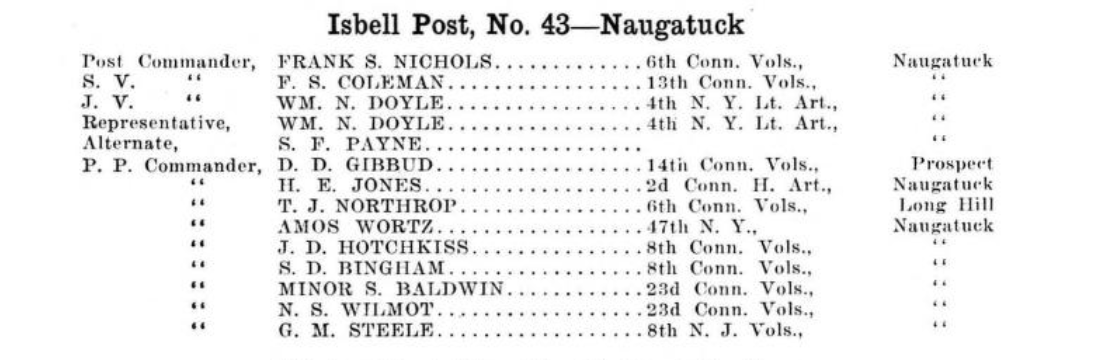
1913 Roll Of The Connecticut Grand Army Of The Republic - Page 18
Online Research Library
Record of Service Men in the Army & Navy of the United States during the war of the rebellion
Postcard Addressed to Miss Eva Benham, Naugatuck, Conn - https://www.loc.gov/pictures/item/2011648589/
CONNECTICUT PHYSICIANS IN THE CIVIL WAR - https://share.google/ohRPDf0FTF2kW1fC4j
1913 Roll Of The Connecticut Grand Army Of The Republic GAR CT
Online Research Library for Connecticut Involvement
The Complicated Realities of Connecticut and the Civil War
Research Guide to Civil War Materials at the Connecticut State Library