
Center School
Naugatuck opens first school in 1731
As Naugatuck was seeking its independence as a separate town, the school districts — which numbered as high as eight at one time — were fighting to retain their own autonomy.
Perhaps some of that Yankee stubbornness was simply rearing its head. And it wasn’t until 1920 that the schools were finally consolidated into one borough district.
Here’s a look into the past.
Center School was Naugatuck’s first schoolhouse. Built in 1731, it was a rustic, one-room clapboard structure, much like all the schools of the era. But for nearly 120 years more, the schools didn’t change much, except for the wood stoves that replaced the open fireplaces.
In the early days, it is believed that teachers went from one school to the next, boarding for four to six weeks in each.
When Judd’s Meadow became Salem Bridge in 1773, the society organized its own school committee. Local taxes of five pence to the pound were voted for the schools, and a local collector was appointed.
Additional schools were constructed in school districts that formed by the start of the nineteenth century: one in the Southwest District near the limits of Gunntown, another east of the river in 1778 for the Middle School District (which included sections of Milford and Derby); a third in the Pond Hill District in 1790; a fourth in Lewistown; and a fifth in Patridgetown.
Early in the new century, two additional districts were added: Straitsville in 1825 and the City District in 1830. Each district appointed its own school committee, maintained the schools, raised money for its own programs and supervised the teaching of the children.
Straitsville brought about the first graded school in the region, constructing a two-story schoolhouse. But for the most part, schools were ungraded, and pupils from 4 to 20 years old were crammed into rooms originally designed for half their number.
It was a young lawyer and member of the Board of School Visitors, General Stephen W. Kellogg, who sought the advice of Henry Barnard, Connecticut’s first Superintendent of Schools, about the appalling conditions of the schools.
Barnard agreed with Kellogg that the best solution was to consolidate the districts and construct a new, graded school that would include Naugatuck’s first high school.
Opposition to the proposal was bitter.
Only five districts — Center, Patridgetown, Lewistown, Union City and Pond Hill — agreed to consolidate. The three other districts remained autonomous.
The town raised $4,000 to build a central school and received approval to borrow another $2,500 for the new Union Center School district. The new school was built at the far end of the village green between two churches. It opened in 1852, the high school occupying the top floor, the elementary departments on the lower.
But the union of districts didn’t last. For some obscure reason, Union City withdrew in 1856, followed by Pond Hill.
New schoolhouses continued to be built in the districts with great assistance from private philanthropy. Salem School and the new high school, now Hillside School, were paid for by Naugatuck’s leading benefactor at the time, John Howard Whittemore, while Whittemore’s son, Harris, shouldered the cost of the new Hop Brook School.
Just prior to 1920, there were still seven school districts and 12 schools. Operations were directed by Superintendent of Schools Harold E. Chittenden, a six-member Board of Education, a three-member High School Committee and 10 members of the district committees.
After years of pleading for consolidation by the Board of Education, which had replaced the Board of School Visitors, consolidation of the districts was finally achieved.
Today, there can be no doubt that it improved the standard of schooling.
— ELLEN K. EHMAN
Source: Special Edition of the Naugatuck Daily News (1844 - Naugatuck Sesquicentennial - 1944)
Prior to incorporating in 1844, Naugatuck was know as Salem Bridge and previous to that, Judd's Meadow. The following is from William Ward's book "The Early Schools of Naugatuck", described as a brief history of our school, teachers, text book, etc. from 1730 to 1850. The text describes the boundaries of the Center School District, one of several that existed in town:
At a meeting of the Ecclesiastical Society of Salem held December 1st,1777:
"Sett off a District for schooling on the East side of the River, beginning at Nathan Porter's malt house (near what is the junction of South Main and High streets), to extend North as far as the road-and include all inhabitants from the River a quarter mile East of New Haven road (now High Street), and to extend near Mr. Jude Hoadley's house."
Colonial America had a close relationship between churches and government in setting up and running schools. The Society oversaw local schools until the late 1790s.
The development of the schools in Naugatuck reflects the changes in the town as it grew with the expansion of industry.
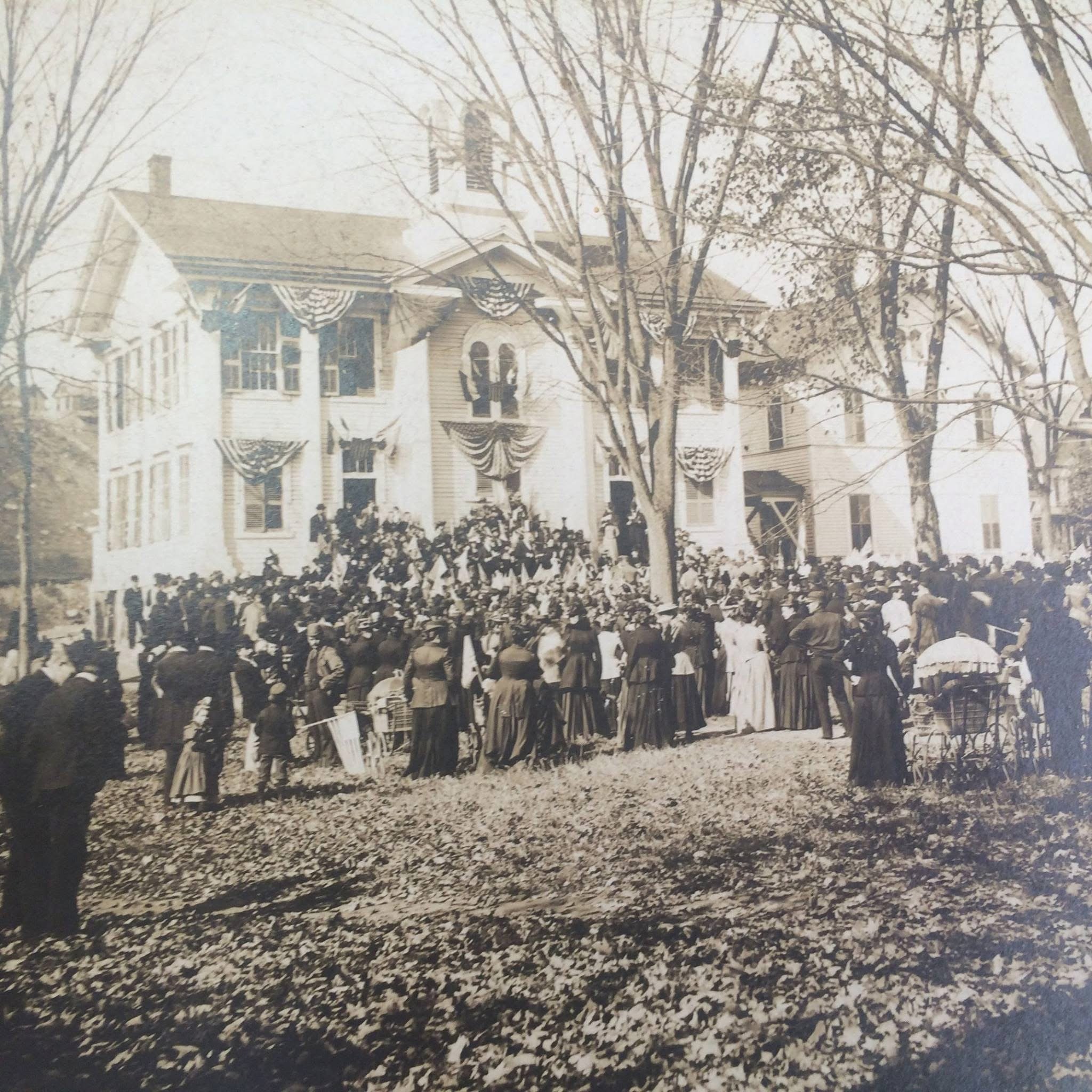
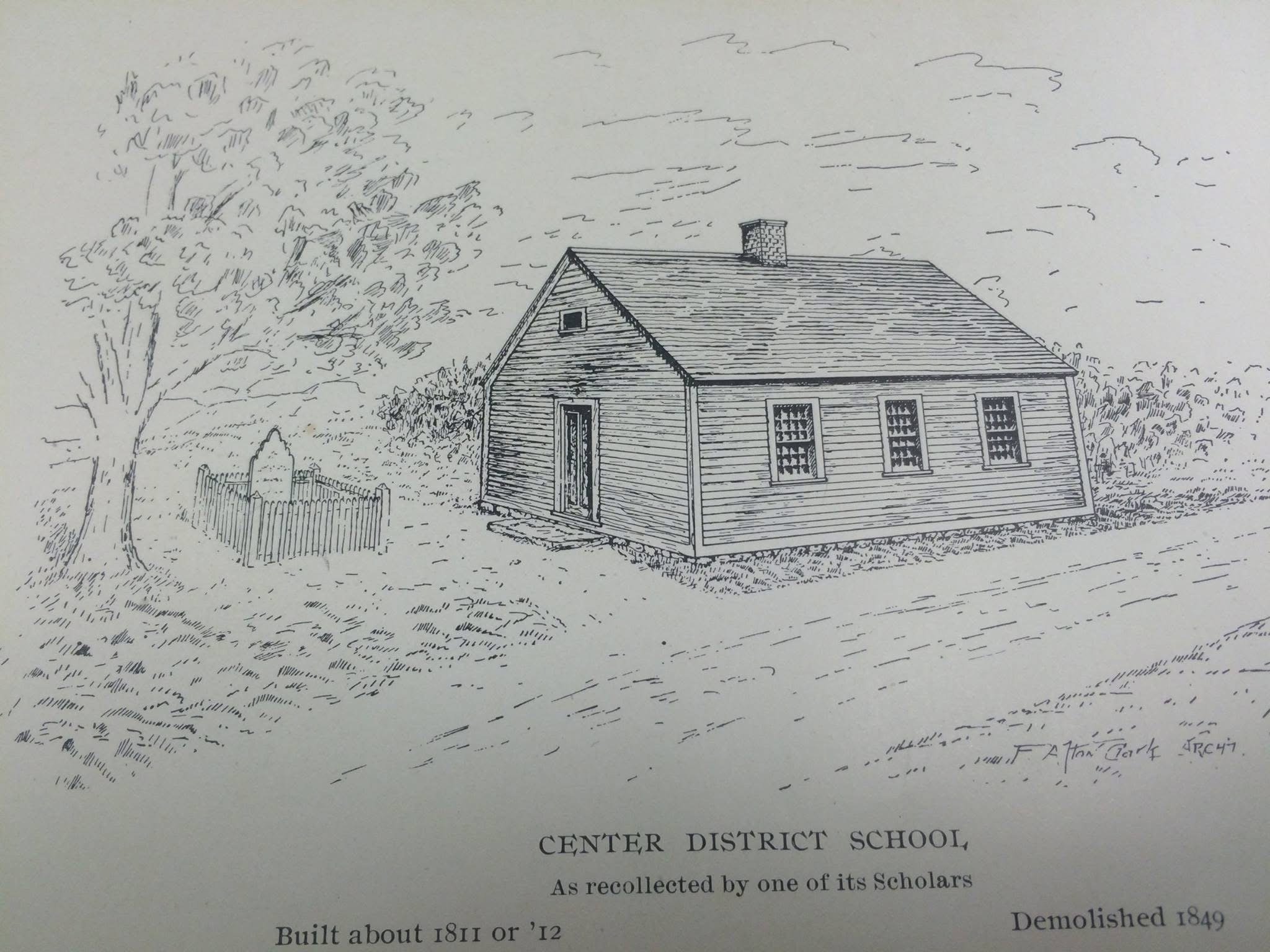
Pictures are the Center District school; the drawing is one that was built around 1812 and torn down in 1849. The photograph is the Center School located on the Green and what is now Meadow Street on Columbus Day 1892. This school was built in 1852 and torn down in 1893. Salem School replaced the Center District school in 1895; with the High School on the upper floors.
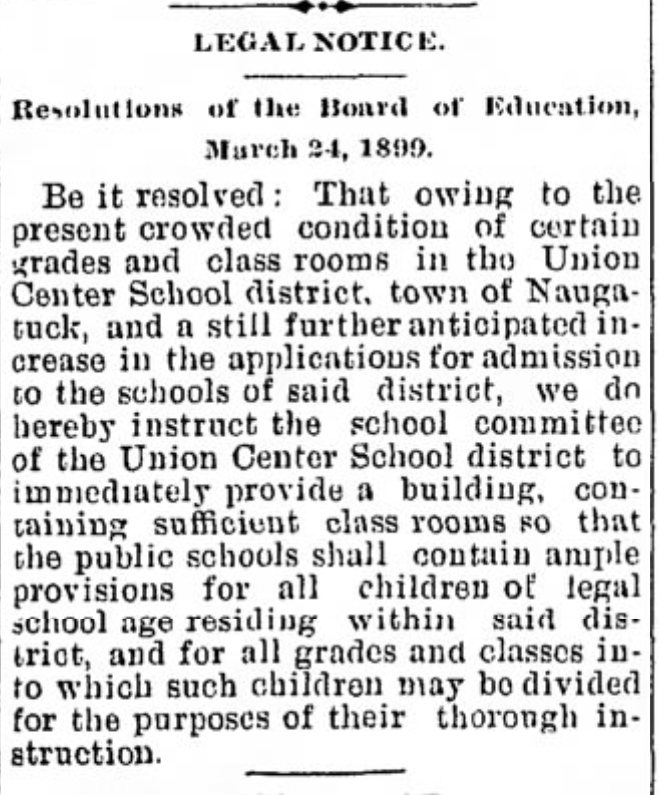
Naugatuck Daily News - Sat, Apr 01, 1899
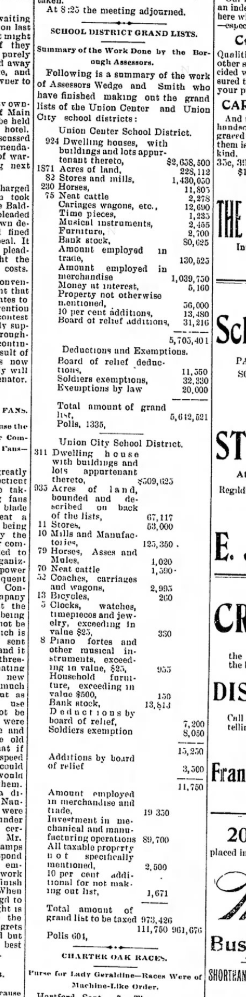
Naugatuck Daily News - Fri, Sep 07, 1900